
- Date of visit: April 23 2026
- Post office visited: General Post Office Mbabane
- Cost of sending postcard: Cost of sending a postcard: Europe 5.90 SZL (€0.30), USA and Canada 7.70 SZL (€0.40), by envelope mail 14.10 SZL (€0.75).
- Postcards available at: a bookstore in the Swazi Plaza shopping centre and two stamp-themed cards at the main post office.
- Delivery time: fastest 21 days to Germany
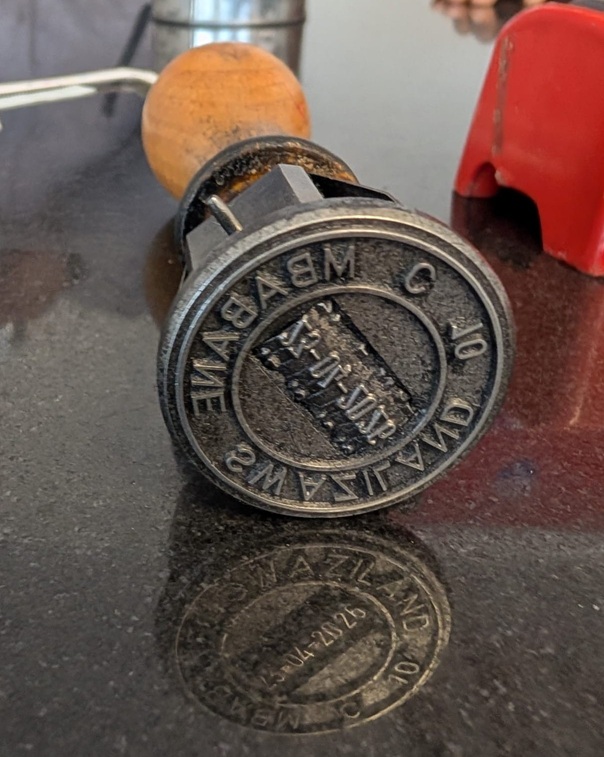
Eswatini is a small landlocked kingdom in southern Africa, squeezed between South Africa and Mozambique. Africa’s only absolute monarchy, it is home to around 1.2 million people and ruled by King Mswati III. The country was known as Swaziland until 2018, when the king renamed it Eswatini — “land of the Swazis” — on the 50th anniversary of independence.
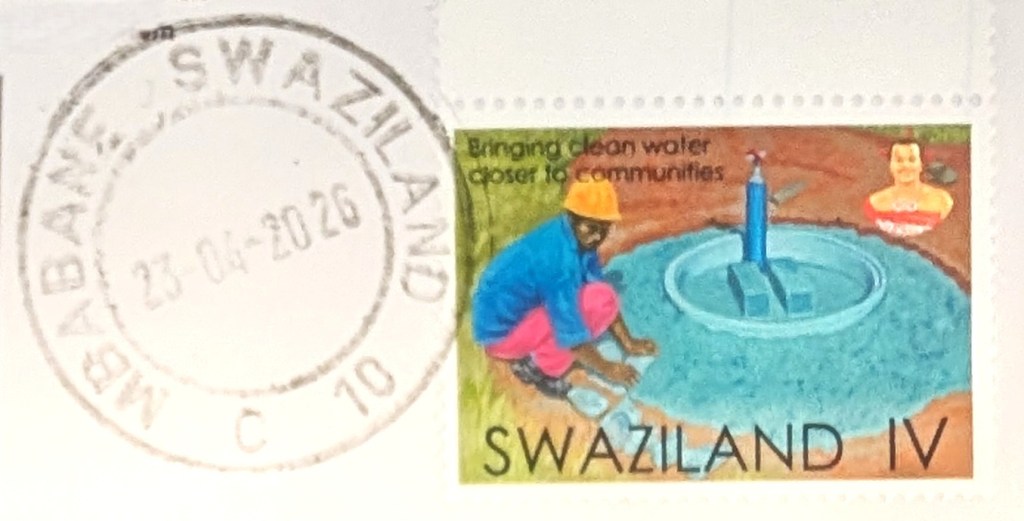
The first stamps appeared on 18 October 1889, overprinted Transvaal issues marked Swaziland. After the Second Boer War, the territory passed to British administration in 1902, and dedicated Swaziland stamps returned only in 1933. The kingdom gained independence on 6 September 1968, and the postal service grew from there. Since 2018, stamps carry the name Eswatini.
Today, postal services are run by EswatiniPost, part of the state-owned Eswatini Posts and Telecommunications Corporation (EPTC).
Our visit to Kingdom of Eswatini.
I’m not entirely sure why, but whenever I enter a kingdom, I find it irresistible. Maybe it’s childhood fairy tales, maybe the influence of the long-reigning and steady Elizabeth II. Either way, whenever a country has “kingdom” in its name, I am always excited.
The king, Mswati III, could hardly be more different from Elizabeth II. Some of the facts and rumours surrounding him and his kingdom were absurd enough that I felt compelled to write a few of them down here:
King Mswati III. Facts and Rumours from Eswatini.
Known for his many wives and lavish lifestyle, he has made headlines for reasons far removed from duty and restraint. As it happened, we arrived at just the right moment: preparations were underway for celebrations marking his 40th year on the throne and his 58th birthday.
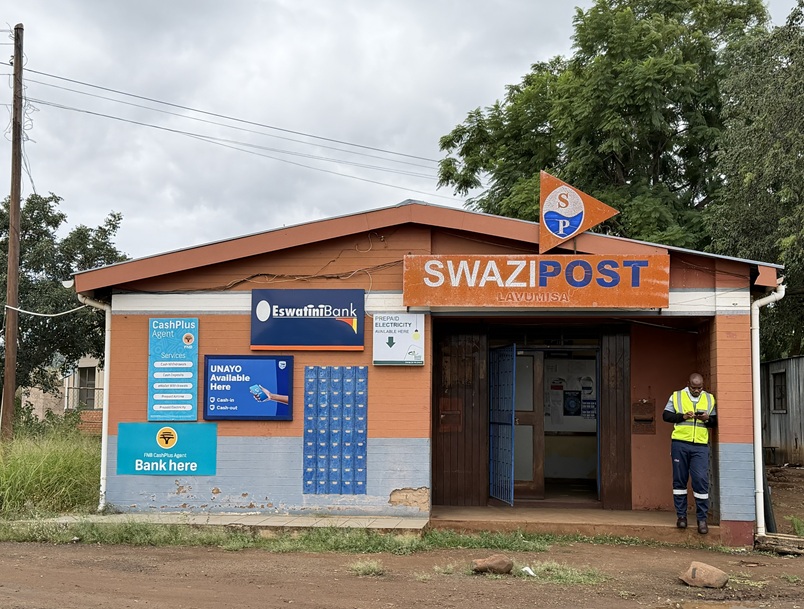
On April 21, we crossed through the Ngwenya Border Post by car from South Africa into the Kingdom of Eswatini, arriving in Mbabane in the evening – too late for the post office. We had not been able to find postcard rates online beforehand, and our emails to Eswatini Post had gone unanswered. The following morning, our first stop was the post office in Swazi Plaza. The clerk was friendly and helpful, and had a straightforward answer to our main question: sending a postcard anywhere in the world costs 14.10 SZL, remarkably cheap compared to postcard rates back home in Estonia.
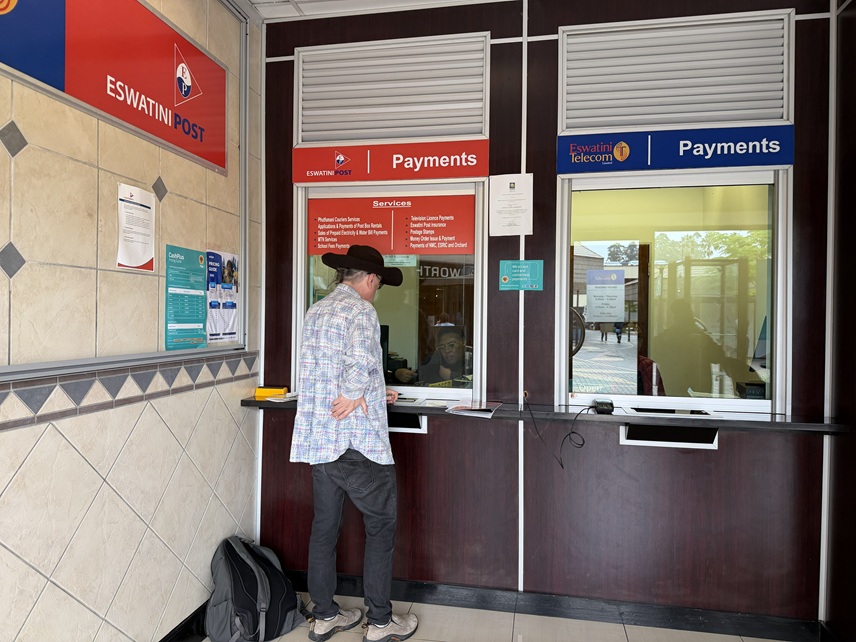
We had also bought some stamps from European philatelic resellers beforehand. Some carried no numerical value — only letters from A to D and Arabic numerals from one to six. The clerk could only confirm that the “A” stamp covered the 3.90 rate. After several unsuccessful attempts to reach someone by phone about the others, she promised to have answers by the next day.
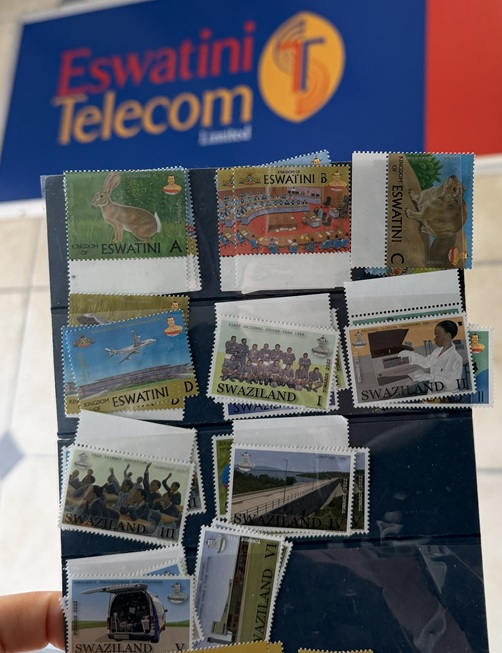
We stocked up on stamps and headed out to explore. Postcards were not available at the post office, the hotel, or souvenir shops. The only place we found them was a bookshop in Swazi Plaza.
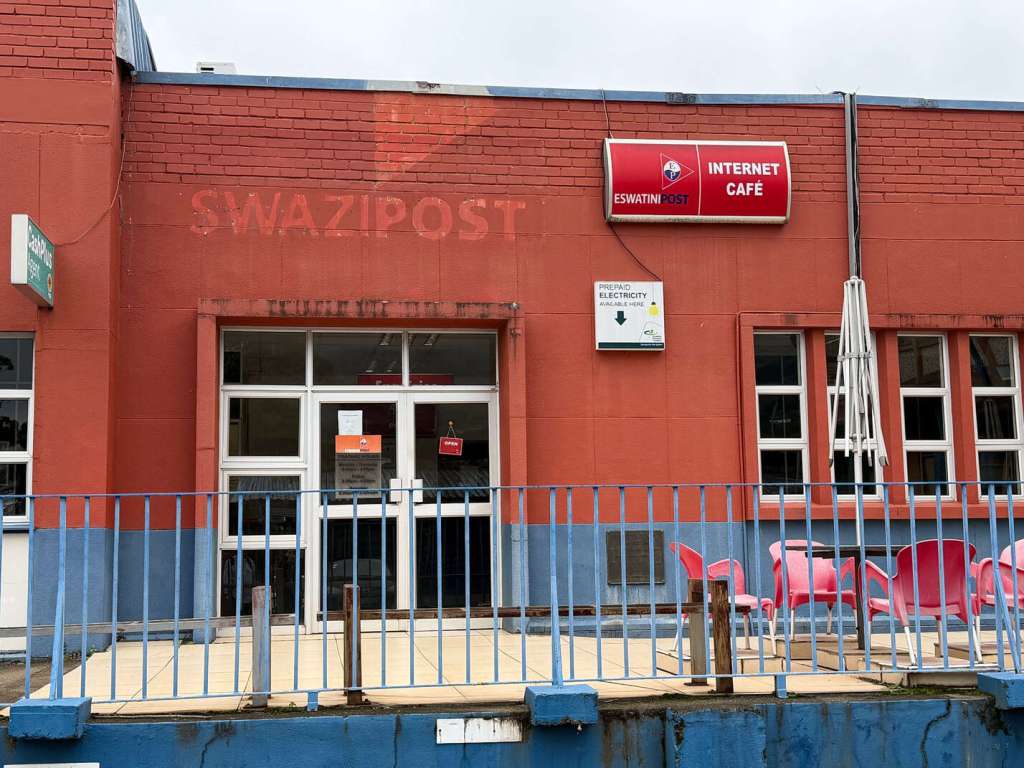
As most of the country’s main sights lie outside the capital, we quite quickly found ourselves at the main post office on Mahlokohla Street, a little away from the city centre. It was a red-brick building with a security-guarded parking area. Inside were several service counters and even an internet café through a side door.
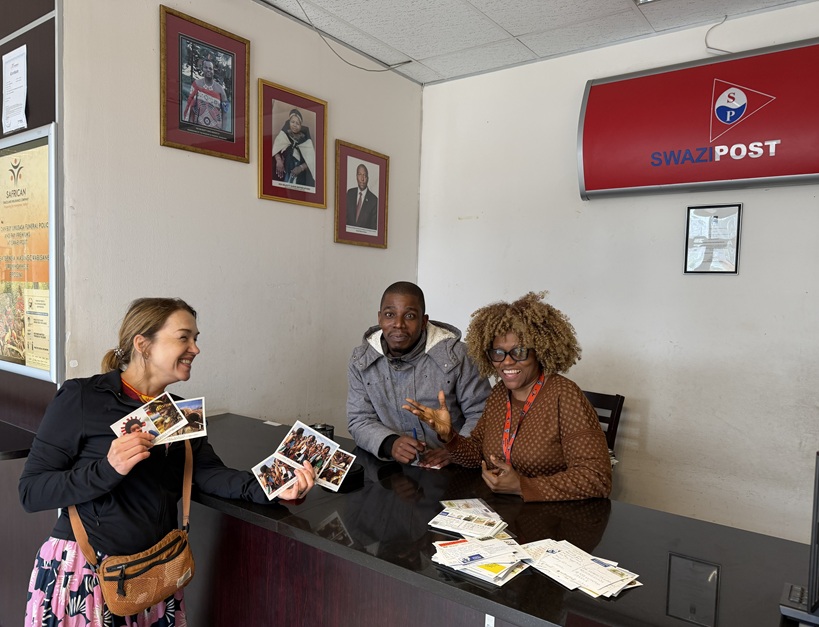
Inside, directly opposite the entrance, was a wide counter. On the wall behind it hung framed portraits of the king, the queen mother and the prime minister, next to a large Eswatini Post sign. Behind the counter stood a smiling clerk. Several service counters stretched further into the building, and there was even an internet café through a side door.
Hearing that we were interested in buying stamps, he pulled out a thick folder filled with them and placed it on the counter in front of us. The answers to our questions about postage costs turned out to be different from what we had been told that morning — the earlier rates had apparently been for envelopes rather than postcards — and to prove it he showed us a printed price list with countries and rates by destination.
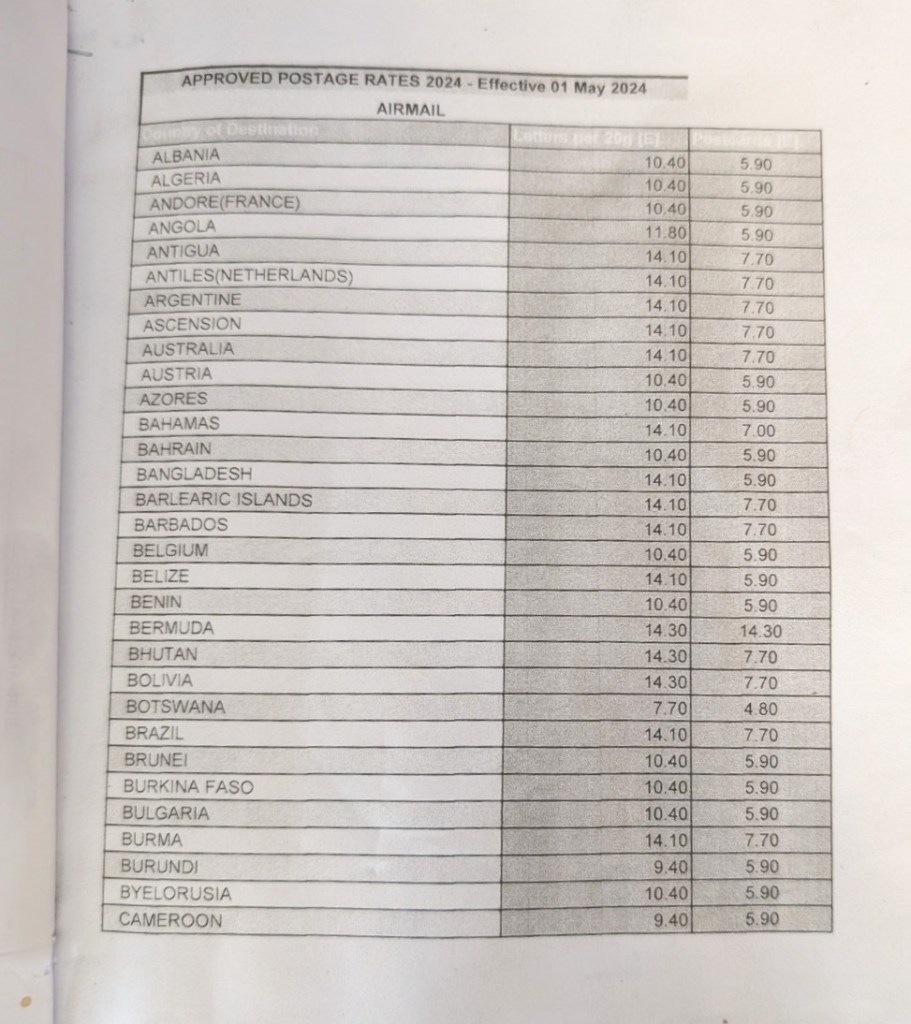
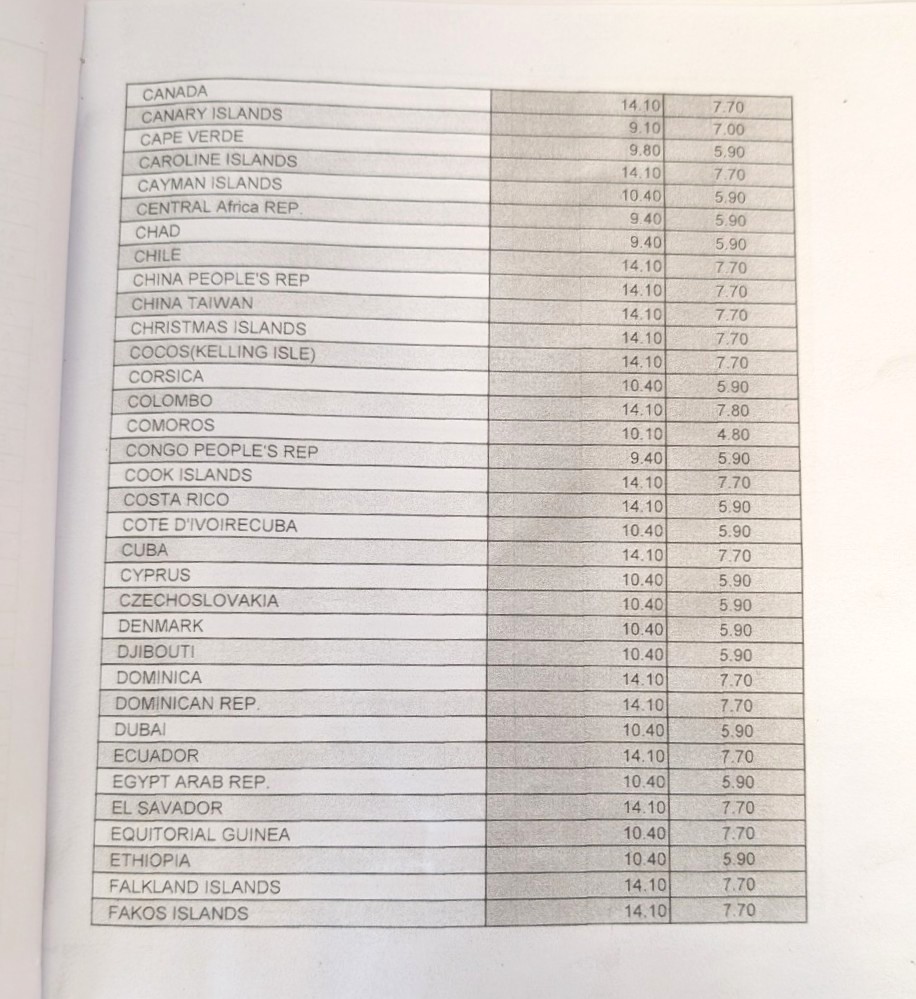
To clear up the meaning and prices of the stamps marked with letters and Roman numerals, another employee came from the back office to help us.

Tempting, but our plans were already fixed. Still, wanting to experience at least a little of the royal atmosphere, I asked where the king’s palace was, if only to see it from afar. One of the clerks marked the location on Google Maps and, exchanging amused smiles, told me I should definitely go — perhaps I might even see the king.
A true royal enthusiast should at least try, I told myself.
After stamping and cancelling all the postcards I had prepared, I left Andry at the post office and set off alone, the Estonian flag attached to the car in the hope that, among all the foreign representatives arriving for the celebrations, I might be mistaken for one of them. I dressed as formally as the trip allowed — in a long pink dress, with a bag of Estonian Kalev chocolates waiting in the car just in case.
The road led out of the city, through a neighbouring town and eventually into the forest. There was a barrier across the road, but otherwise the road was unmarked, hidden among trees. At first I thought I had taken a wrong turn. Then two extremely serious-looking guards with rifles stepped out of a small guard booth, and it became clear I was the right road, but that was as far as I would get. So I did not see the palace. Nor the king.
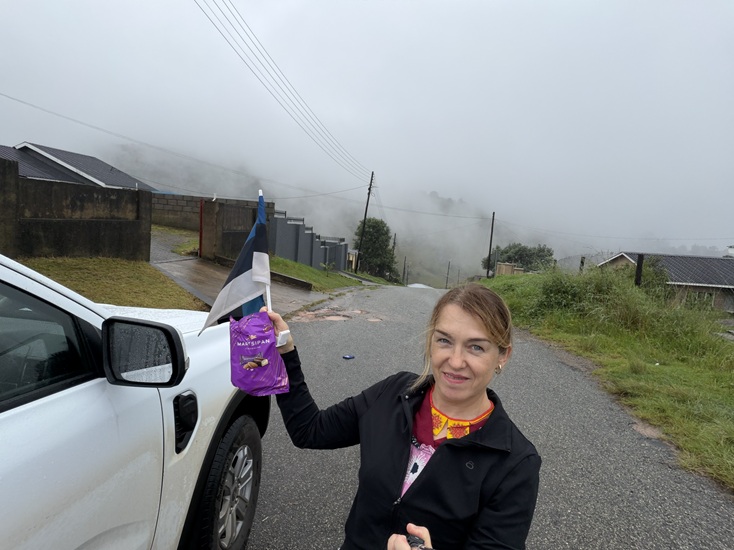
The chocolates, however, did not go to waste — we left also them at the post office instead. The people working there had certainly earned them.
Later that evening over dinner, I asked about the king’s life, not the current one, but his father, who according to different sources had between 70 and 125 wives. How could he possibly remember all his children’s names? A local woman at our table said that remembering the children’s names is the responsibility of the wives, and added with a laugh that for her husband, one woman like her is more than enough. She also noted that while many things are said about the king, very little of it had much to do with her everyday life.
As we left the country, the radio was filled with formal congratulations to the king — including from Eswatini Post. So we did not miss the celebrations entirely after all.
At the same time as the royal celebrations, a very different challenge was waiting for me in another country. But that is a story for the next post.
Anyone concerned about our health following our recent Saint Helena visit and the hantavirus situation: MV Hondius arrived two days after we left.
By now, all postcards from the lottery are on their way to their lucky recipients. And for those who supported the project with a donation and cannot wait for the postcard to arrive, I also took pictures of the postcards before mailing them. Happy to send them on request.
For now, that is all. The next post should appear in about two weeks.
If you’d like to read future entries from my Post Office Diaries, you can subscribe here.
Photos © nexttrip123.com — please credit and link back if used.
 Exploring the Unexpected