
- Visit date: 22.06.2025
- The visited post office: Balzers Post Office
- Cost of sending mail: Local 1.20 CHF Europe 1.90 CHF (about 2,05) EUR, Wordl 2.50 (2.70 EUR)
- Postcard Delivery Times: fastest to Germany, 4 days, to USA 7 days
Though Liechtenstein is tiny—just over 160 km² with under 40,000 residents—it boasts a surprisingly rich postal heritage. Prior to 1912, its mail was handled by the Austrian postal system, with post offices in Balzers (since 1817, reopened 1827) and Vaduz (from 1845).
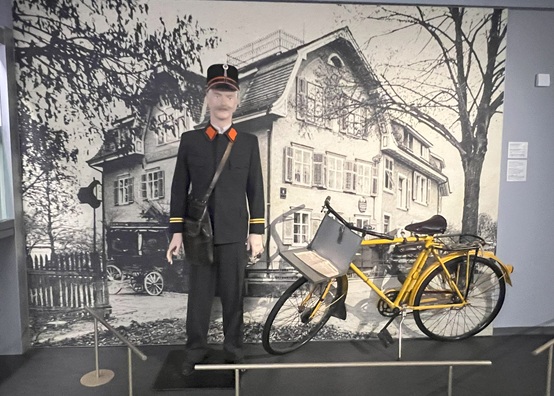
An 1911 agreement allowed Liechtenstein to start issuing its own stamps. Consequently, on 1 February 1912, the principality released its first postage stamps. Following the collapse of Austria-Hungary in 1918, Liechtenstein seized postal sovereignty and issued fully independent definitive stamps in July 1920. Although Swiss currency and systems were adopted soon after, true postal independence arrived in July 1920, with the shift to Swiss management beginning on 1 February 1921
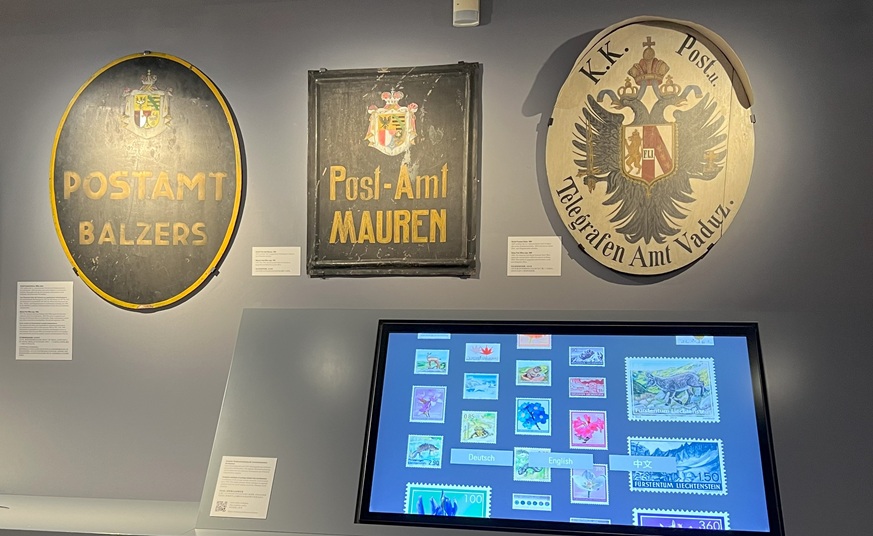
From 1 February 1921 to 31 December 1999, postal services were formally administered by Swiss Post via a bilateral treaty signed in November 1920. On 1 January 2000, Liechtenstein reinstated full control over its mail through the creation of Liechtensteinische Post AG, a state-owned company.
Useful links: Postal Museum, post.li, philatelie.li, wikipedia, postal history
Our visit to Liechtenstein fell on June 21–23, and it wasn’t just a random stop. The date was chosen for us by a group of Postcrossers who had decided to hold a meetup on June 22. Despite the country’s small size, this was already the fifth official Postcrossing meetup in Liechtenstein — but the very first one in Balzers, the town where Liechtenstein’s first post office opened in 1817.
Liechtenstein’s new stamps are colourful and varied, but we had already planned to bring a broader mix — sourced from European philatelic resellers — to make the cards we sent that day a little more special.
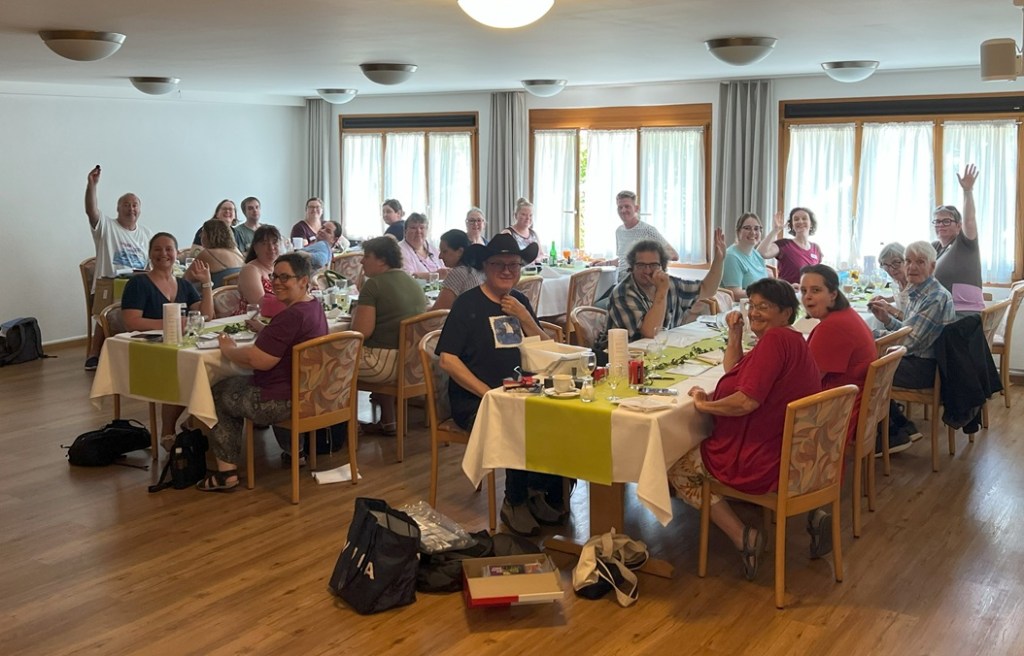
The day of the event was hot and bright. We gathered at Restaurant Falkins, where the organizers had thoughtfully booked us a buffet lunch so we could mingle comfortably and start writing our cards.
That’s when one of the organizers, Marie who works in the Principality of Liechtenstein, came over and informed us that some of the stamps we were using were no longer valid.
What? That couldn’t be right.
When it comes to pre-trip stamp research, I trust Andry completely. He’s meticulous. He was sure they were valid.
Marie was equally sure they weren’t.
But where’s the information to prove it? There was nothing about invalid stamps on the official Liechtenstein Post website.
And yet — she insisted — any cards with those old stamps would not be sent out.
I wouldn’t say it turned into an argument, but it definitely created a little tension.
Andry dove back into the internet while we kept writing.
Eventually, he found the truth — not on the postal service website, but in the archives of the Liechtenstein Parliament, specifically from sessions in 1998 and 2001.
When Liechtenstein’s Old Stamps Became Invalid
In August 2001, the government decided that all stamps issued from 1967 to 1995 would lose their validity for postage starting 1 January 2002, with only a few motifs remaining valid.
A short exchange period ran from January to March 2002, where outdated stamps could be traded in — at face value, minus a 15% handling fee.
The aim? To prevent speculation and bring stability to the stamp market, while strengthening trust in new issues.
Once that was cleared up, we could finally enjoy the meetup in peace. There were around 25 of us, and each handed out 769 signatures or stamps — on cards and in books.
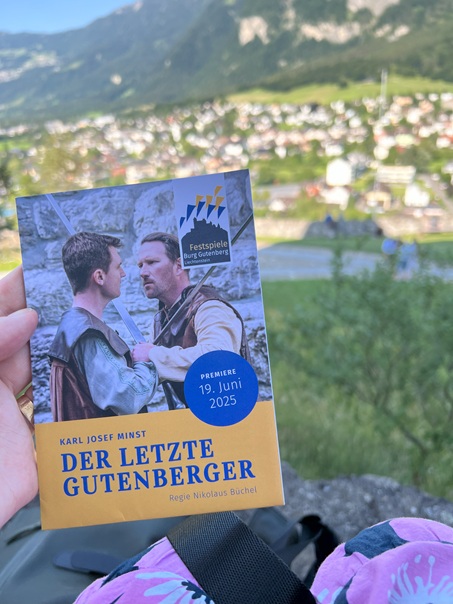
Later in the afternoon, around 4 p.m., we parted ways with our fellow hobbyists, full of postcards and stories. But since the day was still young (despite the 30°C heat), we climbed up to Gutenberg Castle, which towers 70 meters above the town. To our delight, we found that a local theater performance was starting in an hour — and even though the dialect was hard to follow, the show’s energy and physicality made it thoroughly enjoyable.
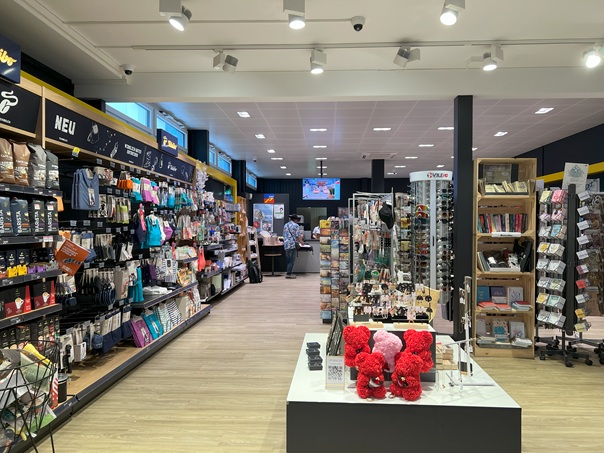
Still not done with postcards….
Although the organizers of meetup had offered to take all correctly stamped and addressed cards to the post office on our behalf, we decided to go ourselves. Partly because, thanks to our new knowledge, we were now short on valid stamps.
So the next morning, as soon as the Balzers post office opened, we were first in line.
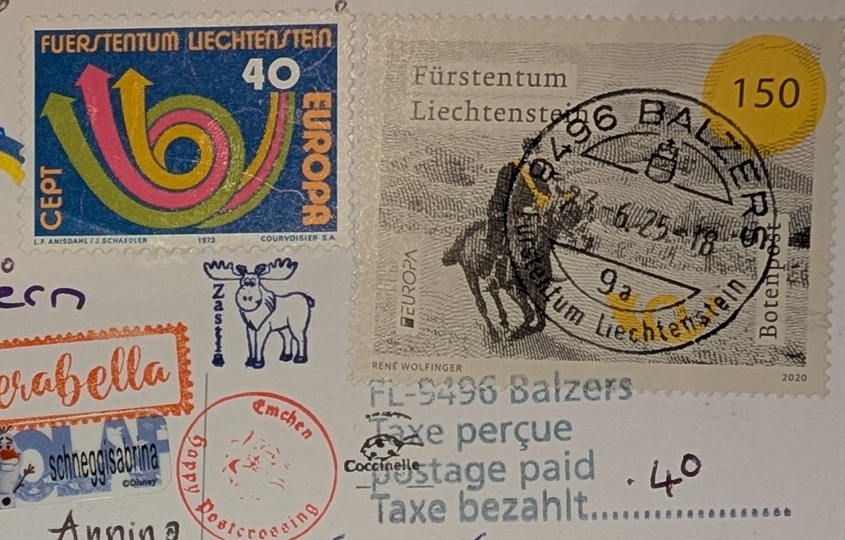
We bought a few more valid stamps and, for some of our cards, asked the clerk to apply a “Postage Paid” handstamp:
“Postage paid, taxe perçue, taxe bezahlt”, along with the handwritten amount we paid.
Less decorative than stamps, but definitely a cool touch — and it included the Balzers postal code 9496.
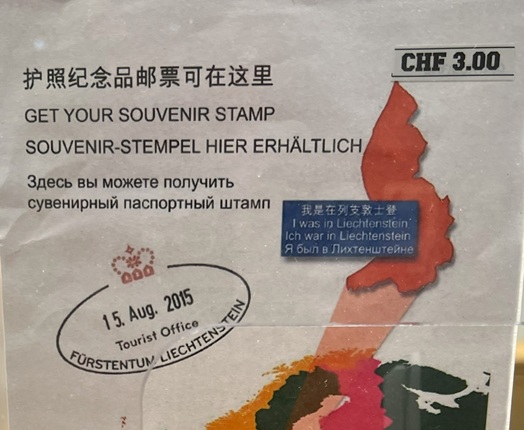
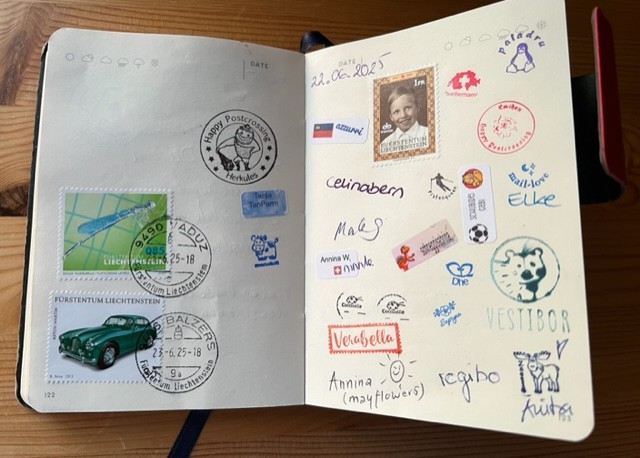
For an extra souvenir from Liechtenstein, you can have your passport stamped — either at the post office or at the Philately Museum in Vaduz — for 3 Swiss francs. The museum itself is small but well put together, with clear displays and just the right amount of detail to give you a good overview of the country’s stamp history.
That stamps really matter here is clear even on the pedestrian street in Vaduz, where the sidewalk is decorated with images of historical Liechtenstein stamps.
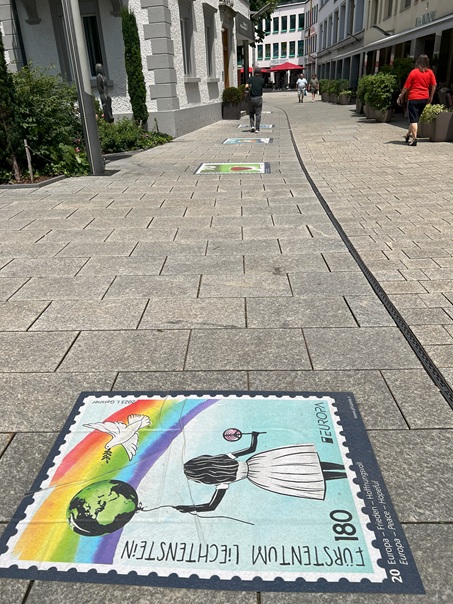
As for our travel journal, we wanted a dated postmark to mark our visit — and yes, both in Balzers and Vaduz, the staff were happy to oblige. We just had to stick a stamp into the notebook first — but not an old one. Even for a souvenir, they wouldn’t stamp anything with an invalid stamp.
And so our postcards from Liechtenstein were properly stamped, postmarked, and sent off.
Not without a bit of confusion, but at least now we know which stamps still count — and which don’t.
If you’d like to read future entries from this post office diary, you can subscribe here:
 Exploring the Unexpected