
- Visit date: June 18 and June 24 2025
- The visited postal landmarks: Kreidesee Hemmoor postbox and Zugspitze post office
- Cost of sending mail: Kreidesee: 6 Eur(incl. waterproof postcard, stamp and courier service from underwater mailbox to post office); Zugspitze: International 1,25 EUR
- Postcard availability: Kreidesee dive center; gift shops in Zugspitze
Between Depth and Height: German Postal Extremes
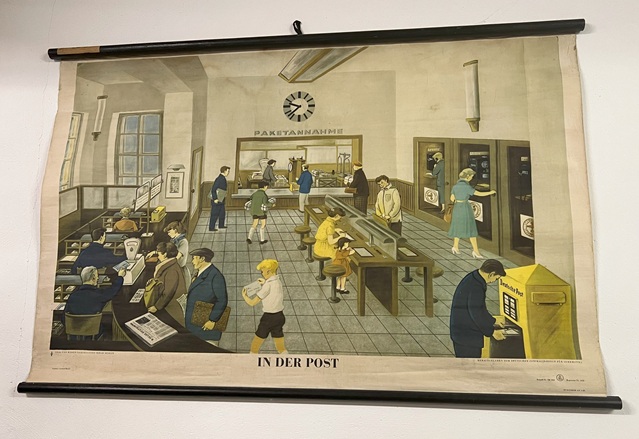
Germany’s postal tradition dates back to the late 15th century, when the Thurn und Taxis family established one of Europe’s first organized courier networks. Over time, this system evolved into a highly structured national service, shaped by unification, industrialization, and technological change. Despite centuries of transformation, German postal services have remained closely associated with reliability, precision, and the idea that mail should reach its destination—no matter how remote or unusual the location.
Today, this legacy lives on not only in bustling city post offices but also in surprising and symbolic places—like the country’s deepest letterbox, hidden 19 meters underwater in an old chalk mine in Hemmoor, and its highest post office, located nearly 3,000 meters above sea level at the Zugspitze, Germany’s tallest mountain.
These two extremes—deep underwater and high above the clouds—show how far the German postal system is willing to go, even when only a handful of letters are involved.
References:Zugspitze, tauchschule-kreidesee., kreideseetaucher
Our personal experiences at different heights of the Deutschen Post…
…beginning with the underwater mailbox at 19 meters deep.
I stumbled upon an article describing a unique opportunity to send a postcard from an underwater mailbox — located 19 meters deep in the middle of Europe. And this story wouldn’t let me go
And since we had planned to pass through that area on our summer road trip (from Denmark to Liechtenstein by car), it seemed like a perfect fit.
Well — almost perfect.
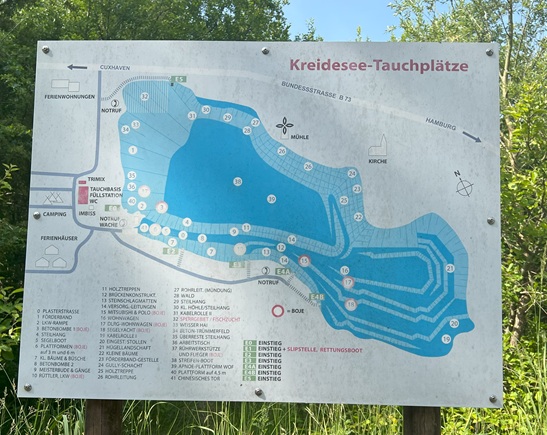
The catch was, while the lake was close by, the mailbox itself was nearly inaccessible. At least for us, and at least on this trip.
The lake where the mailbox is located, Kreidesee, reaches a depth of 60 meters, but even 19 meters — where the mailbox sits — requires a proper diving license.
I had done trial dives with an instructor before, even four times in various waters around the world, but I didn’t have a certificate or enough experience to dive that deep. Still, I really wanted to try.
That morning, we woke up in a nearby village, full of excitement. I knew the chances of reaching the 19-meter-deep mailbox myself were close to zero — but I hadn’t lost hope just yet. At 9 a.m., we met Lars for the first time — smiling and waiting for us outside the dive center.
So, how does it all work?
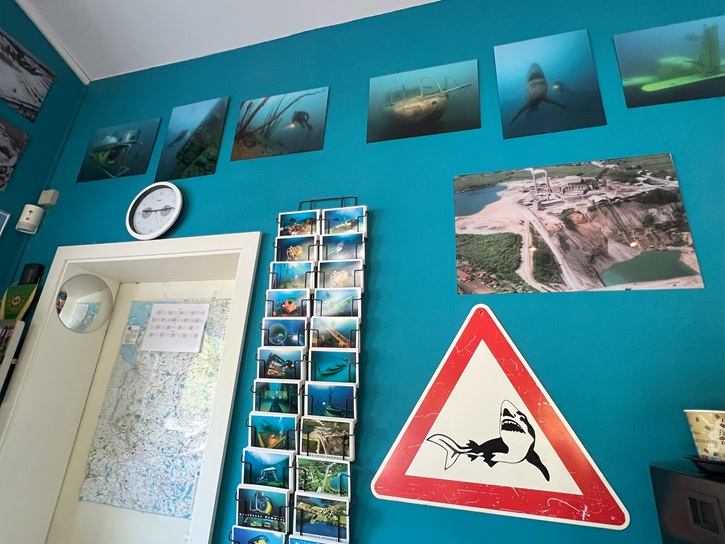
Thanks to a happy chain of coincidences — I was put in touch with Lars, for me the underwater postman.
So we agreed in advance to meet on June 18 at the Kreidesee dive center in Hemmoor.
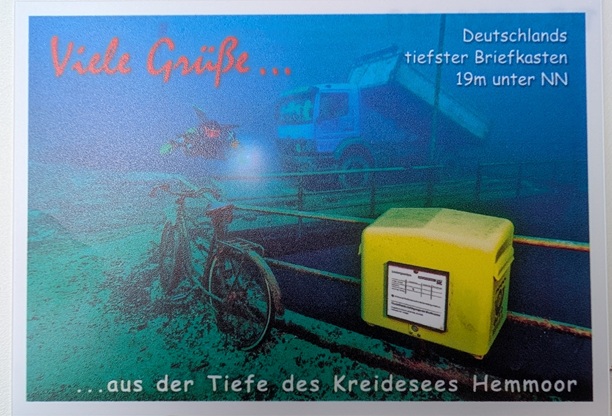
Inside, they sell waterproof postcards; €6 per card, and a few fun designs to choose from; outside is a table with waterproof markers.
You write your message, dive into the lake, post it in the underwater mailbox. Later, someone retrieves the cards, sticks on the stamps, and off they go.
Well… almost officially.
It’s the dive center that takes care of collecting, stamping, and sending the postcards — and they do it with care, ensuring each one makes its way into the regular mail system.
The mailbox is just one of many objects the diving club has placed in the former chalk quarry — there’s even a sunken airplane, an underwater forest, car, shark, gates…
But I came for the mailbox.
Lars empties it about once a week — or someone else does if he’s not available.
I asked, just in case, if there was any way I could get down there myself.
Lars said he couldn’t guide me, but he brought in an instructor, Hendrik.
They discussed.
Nope. Still no way.

12 meters is the maximum for a guided beginner dive.
And 19 meters? That’s deep — the water pressure there is like having two people your size lying on top of you. (I read that online.)
Fair enough. Safety first. And honestly, that firm “no” gave me more trust, not less.
Of course, Lars kindly agreed to deliver our postcards himself — a much more reliable method than me trying to dive there.
But could I still go for a dive? Higher up, maybe?
As it happened, Hendrik from Tauchschule Kreidesee had time for a try dive, so we agreed: Lars and Andry would wait for us while we explored the lake.
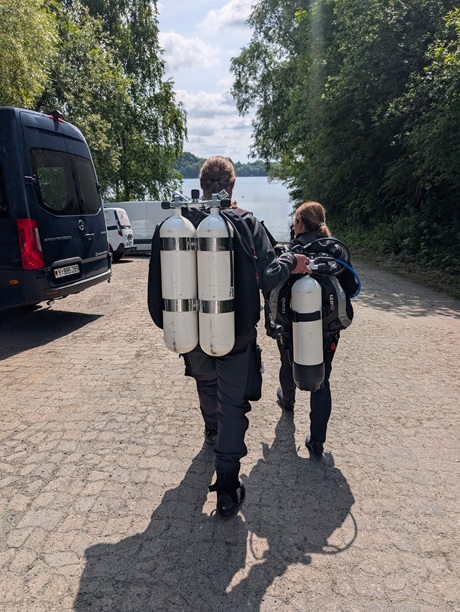
Choosing the right gear and getting through the instructions felt like it took forever.
But I wasn’t in a hurry.
Underwater, I held my nose and blew gently to equalize the pressure in my ears — and then, suddenly, nothing else mattered. It was beautiful.
There weren’t any bright coral fish like in the Red Sea, but that didn’t matter.
From time to time, Hendrik would tap my shoulder and point out details — an object, or a fish drifting past. The submerged forest, soaked in minerals and teeming with life, was perhaps the most magical part for me.
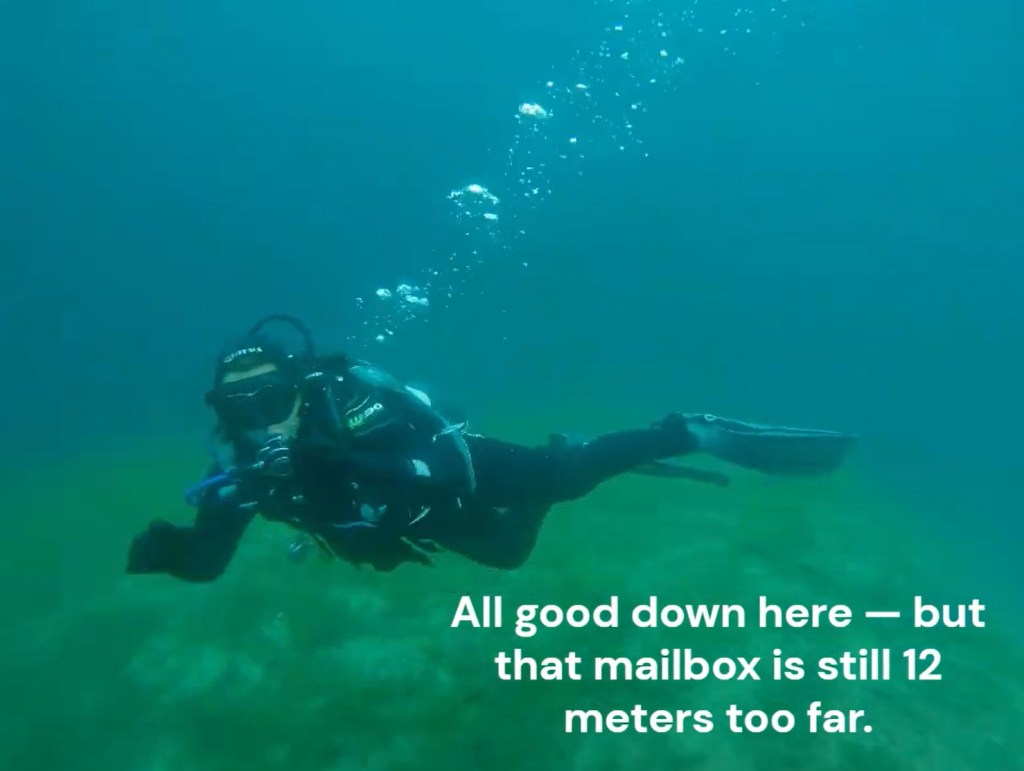
The hour passed like five minutes.
Back on the surface, we met up with Lars again.
What next?
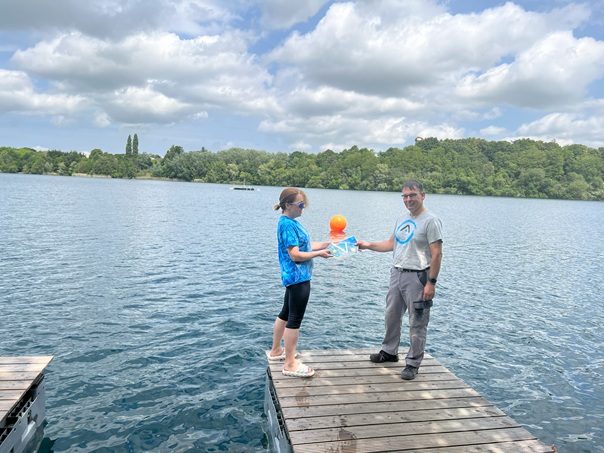
We walked around the lake to a large orange buoy — that’s the spot, right above the mailbox.
We stood there, looking at it — so close, yet still far away.
Well, for us. Not for Lars.
We agreed he would dive and post our cards — not that day, but the next or the one after.
More than fine by me. I had tried.
The mailbox works like any other — with a lock. But Lars doesn’t carry a bag of letters.
He fits all the postcards into the pockets of his diving suit.
He once carried around 150 cards that way, but the mailbox can hold a lot more.
We filled in our postcards, handed them over to Lars, and continued on our way — off to southern Germany.
…and continuing at the post office 2,600 meters above sea level
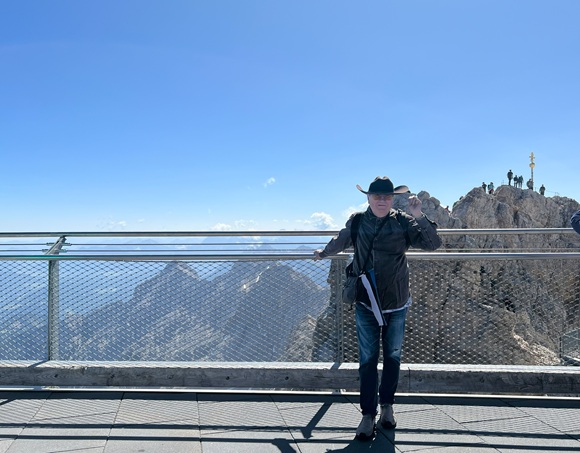
After several days (and quite a few adventures), we arrived on June 24 at the foot of Zugspitze, Germany’s highest mountain. You can ascend from either the German or Austrian side — we chose the German side, starting at Eibsee station.
The cable car carried us smoothly to the summit — arguably one of the most easily accessible national high points in Europe.
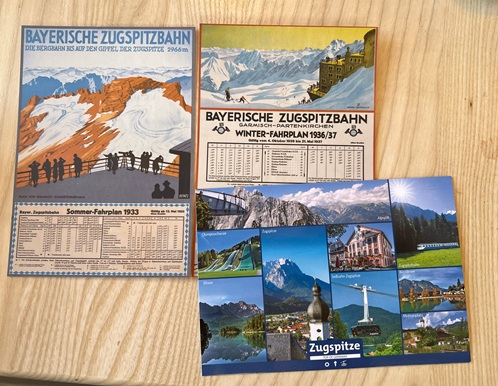
There’s a mailbox near the summit, close to 3,000 meters, just across from the souvenir shop at the top station.
The post office itself is a bit lower, on the glacier plateau at about 2,600 meters. Of course, we were hoping to make it into the post office.
We had already checked the opening hours on Deutsche Post’s website: Tuesday, 11:20 a.m. to 12:20 p.m. But a sign posted on the door added an extra note of caution:
“Achtung: Die Öffnungszeiten ändern sich bei Fahrplanänderungen der Zugspitzbahn AG.”
In other words — opening times may change depending on the Zugspitzbahn’s schedule
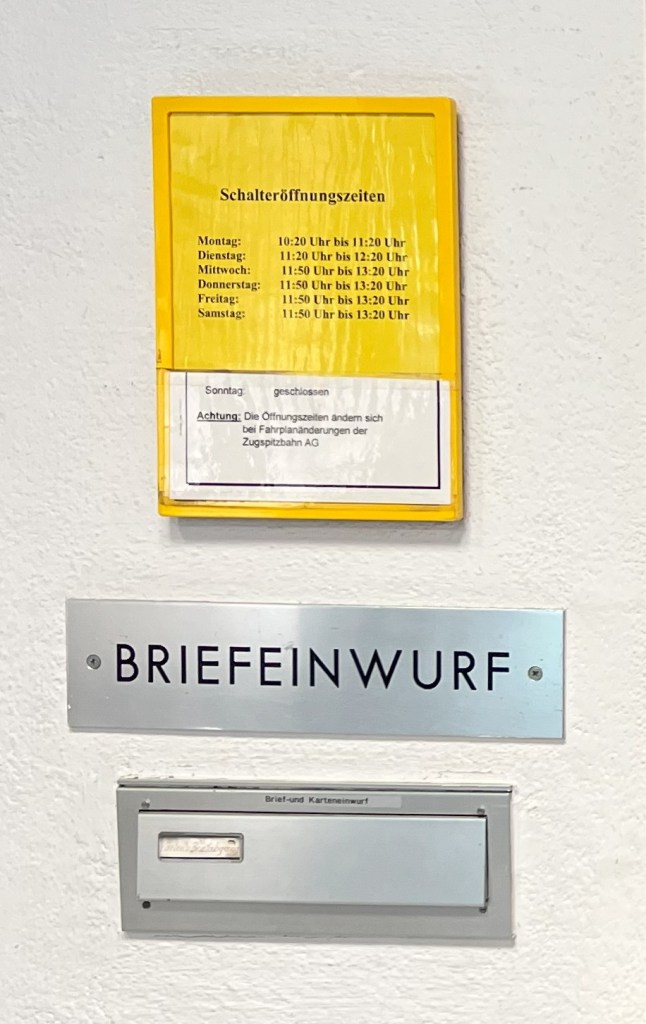
So there we were, right on time, standing outside the post office door.
Closed.
Every 5–10 minutes, one of us went to check.
Eventually, I called Deutsche Post’s info line.
The agent recommended we try another post office.
But this is the only one on top of the mountain!
I asked if she could call someone or give me a number where I could find out more.
She replied, “This is not a call center,” and hung up.
Just as we were about to give up, around 12:30 p.m., a man walked quietly up to the door and slipped inside.
He locked it behind him. No lights came on.
But we heard hammering inside.
We waited another ten minutes. Knocked. Again.
And then — the curtain moved.
Andreas, the postman, realized we weren’t going away. He turned out to be very friendly.
This time, we didn’t get to stamp our cards ourselves — and we didn’t ask.
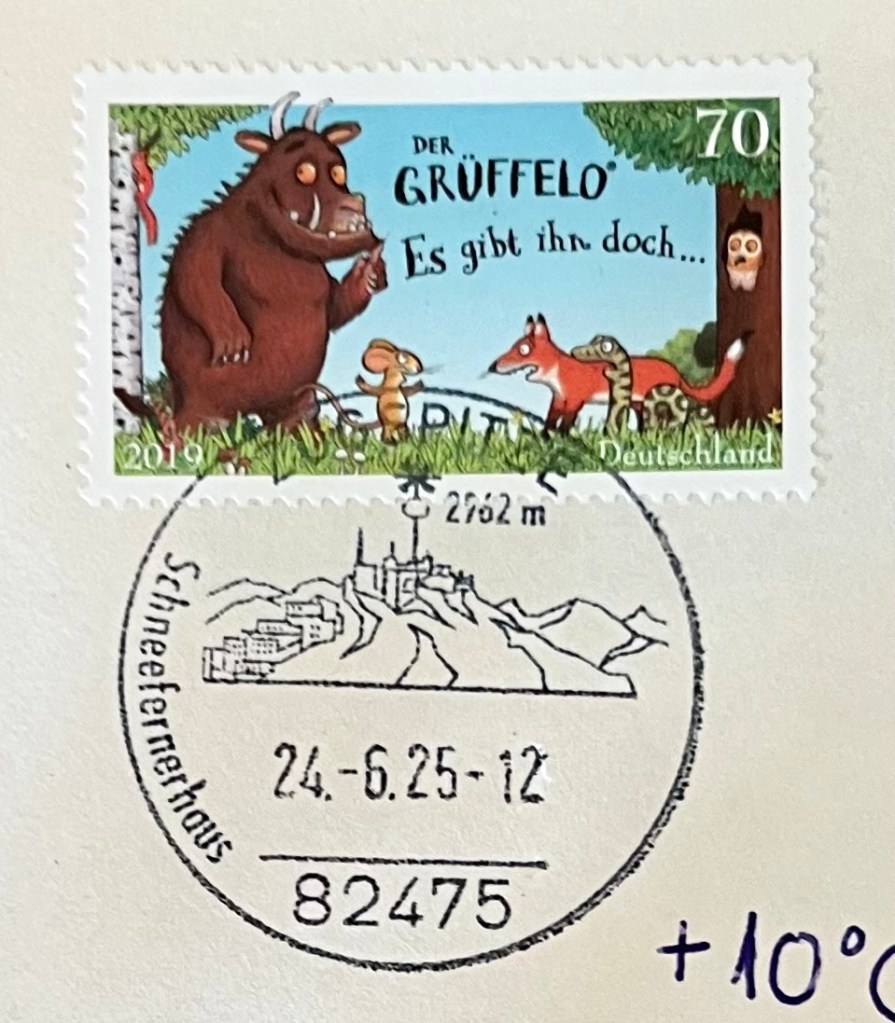
Andreas used a classic hand stamp with a long wooden handle.
He dipped it in ink, tapped off the excess a few times, and then carefully cancelled our stamps.
The result was one of the clearest, sharpest postmarks in my travel collection.
After finishing at the post office, we took the train down – mostly through tunnels – until we reached our car in the Eibsee parking lot.
And we started driving, because we had booked a hotel in Austria for that evening. So, I waved to Germany for this time…
I left happily feeling that our postcards were in very good hands in both cases.
Next week’s post? Still stamped, but from a place with a much more reasonable altitude.
If you’d like to read future entries from this post office diary, you can subscribe here:
 Exploring the Unexpected