
- Visit date: 08.02.2025
- The visited post office: Postbox JQ Rodney Bay Mall
- Cost of sending mail: according to website prices in EC$: 0.80c USA, UK, Canada;
0.85c European countries _ all less then 0,40 eur - Postcard availability: Souvenir shop Crazy Al’s Beach Shack
- Postcard Delivery Times: fastest: 15 days to USA
Updated 14 June 2025: new info from Postcrossers added — scroll to the end of the post for the update!
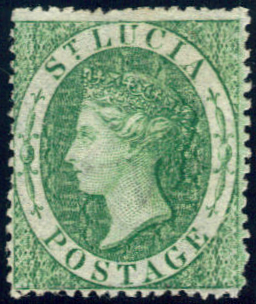
Saint Lucia, often called the “Helen of the West Indies,” earned its nickname because of the fierce struggles between European powers over control of the island — much like the legendary Trojan War was fought over Helen of Troy. Over the centuries, Saint Lucia changed hands between the French and the British no fewer than 14 times before finally becoming a British colony in 1814. The island gained full independence on February 22, 1979, but traces of both French and British influence are still visible today in its culture, architecture, and language.
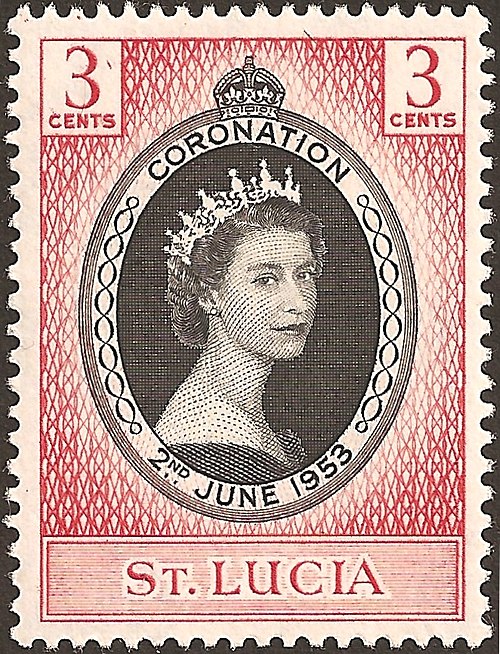
The island’s postal history began around 1844, when the first post office was established in the capital, Castries. In those early days, letters were simply handstamped to indicate their origin from Saint Lucia. The first official postage stamps were issued later in 1860 under British rule, featuring the portrait of Queen Victoria, just like many other British colonies at the time. For much of the 19th century, mail traveled by ship to neighboring islands and across the Atlantic, making international correspondence a slow but vital link to the outside world. Over time, the service expanded with airmail routes and additional local post offices, improving both speed and accessibility. Today, Saint Lucia’s postal system is modern, reliable, and continues to connect this Caribbean paradise with the rest of the world.
References: St Lucia postal price list, postal_history_of_Saint_Lucia, Saint_Lucia, Castries
A Little Postal Adventure in Saint Lucia
This story is actually about a failure. Well — almost a failure. Saint Lucia wasn’t really part of our plan, as we had already visited back in 2014. But it became a stopover on this trip. Our Caribbean cruise ended in Martinique, from where we took the FRS Express ferry to Saint Lucia — just 1.5 hours later, we arrived. The next morning, we had a flight to Jamaica, leaving us with only a half day on the island. Unfortunately, that one day happened to be a Sunday.
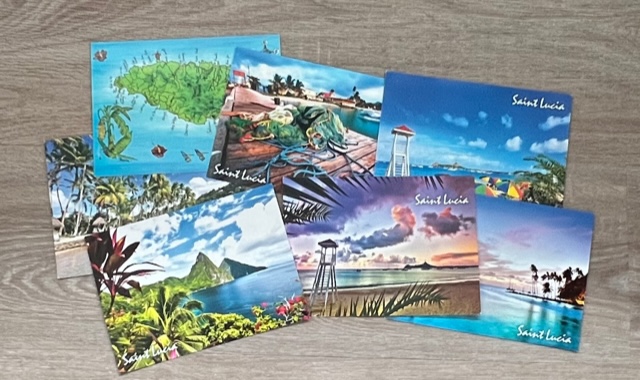
Our first taxi driver brought us to our accommodation Casa del Vega near the airport. He wasn’t optimistic about the post office being open but mentioned he could take us to Rodney Bay if we wanted to give it a try — $35 for a round trip, including waiting time. We checked into the hotel first.
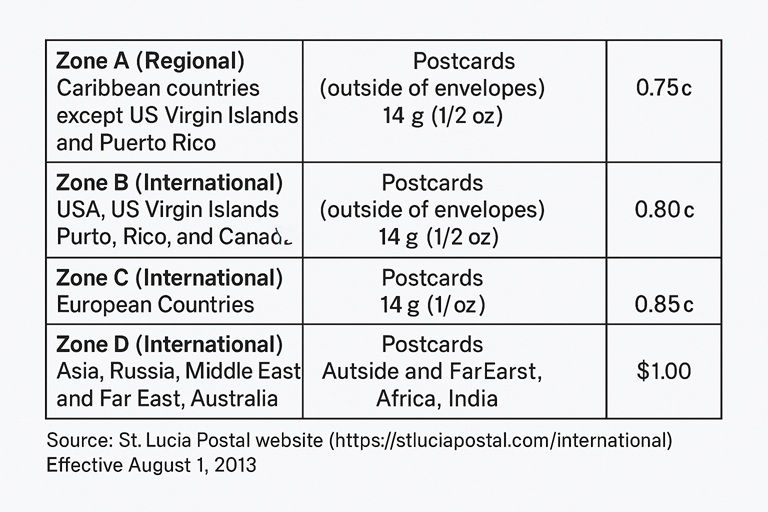
Of course, we had checked postage rates on the official website beforehand, but the prices seemed so cheap — all under 40 euro cents — that we suspected the information might be outdated, especially since the price list hadn’t been updated since 2013.
The owner of our guesthouse reassured us: “You don’t need to know in advance — just go to the post office and you’ll find out.” But well… it was Sunday. Post office closed.
Still, our host tried to help and made several phone calls to souvenir shops and hotels, trying to find someone who sold stamps and knew the current postage rates. No luck. Eventually, she arranged another taxi driver for us — this time $25 for a round trip to Rodney Bay, including waiting time. US dollars are widely accepted alongside the local Eastern Caribbean currency.
Our second driver was young, talkative, and very enthusiastic about showing us his island. He even suggested we skip the post office entirely and instead drive to see the Gros and Petit Piton mountains — a two-hour drive, a two-hour hike, and then straight to the airport. “Sleep is overrated,” he laughed. “You can sleep on the plane.”
As we chatted, I mentioned that I also enjoy driving and have handled some pretty chaotic traffic in various African countries. He laughed and said: “No way. A woman can’t be a good driver. Just not possible.” And laughed again.
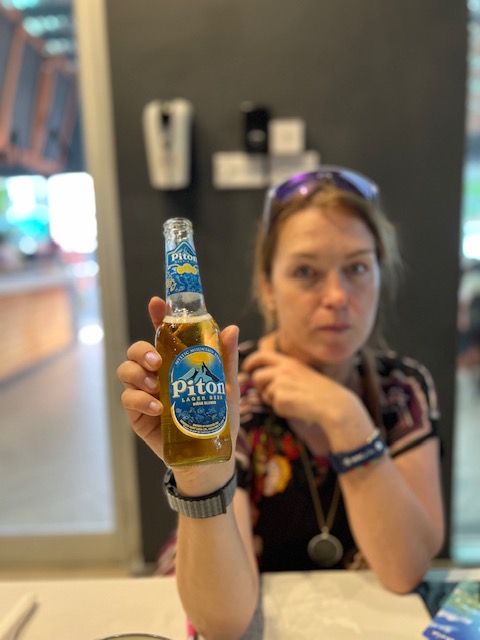
When I shared my usual elephant question — a joke I collect from different countries (“What would you as a local do if you saw an elephant?”) — he answered in true Saint Lucian spirit: “I would grab our famous Piton beer and keep watching.”
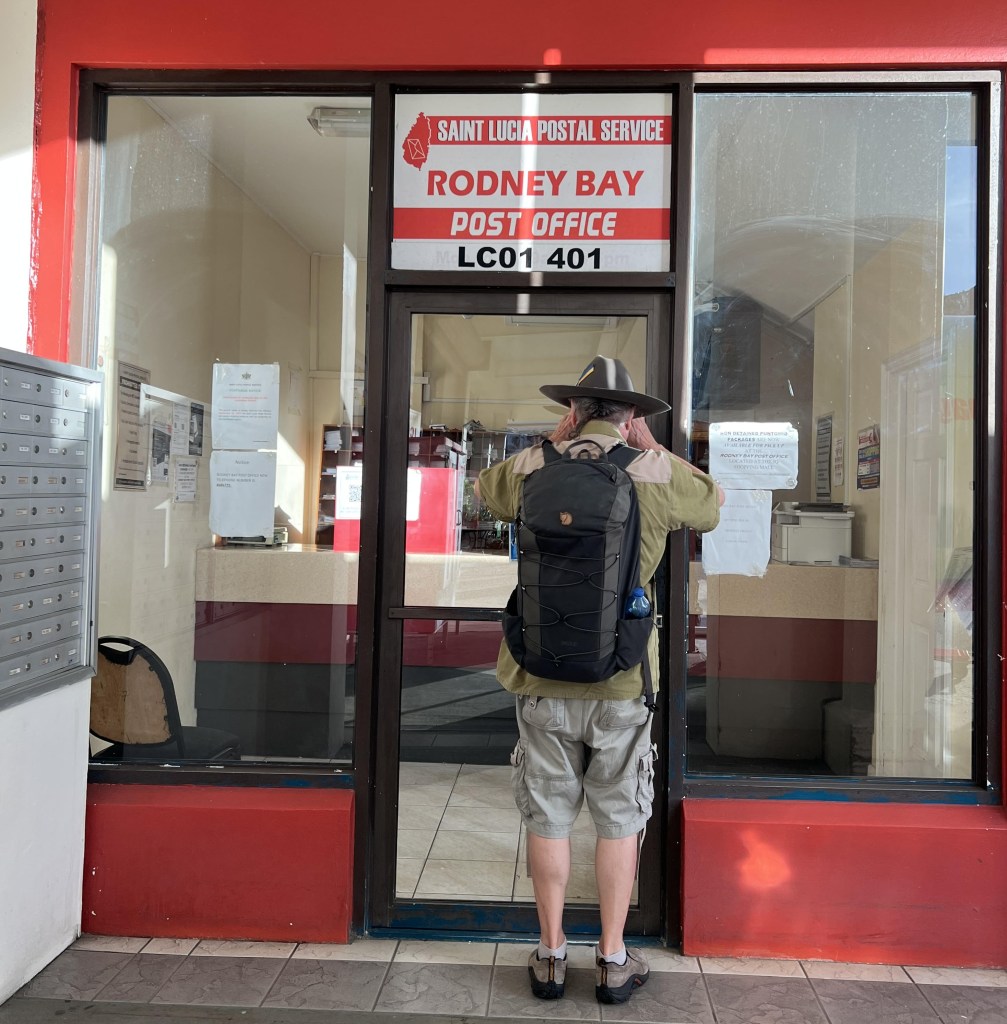
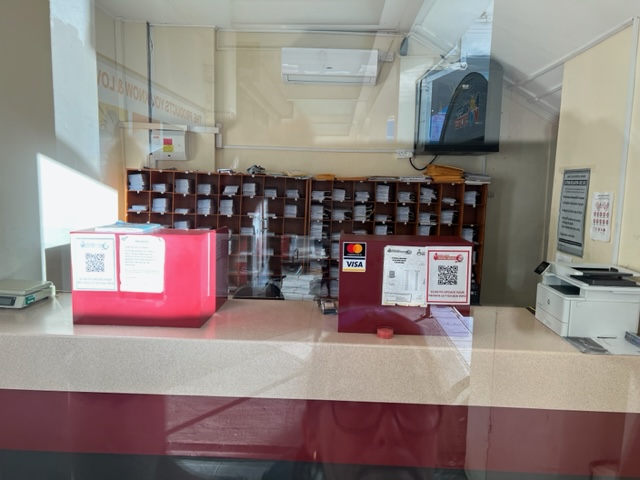
Eventually, we reached Rodney Bay. The post office is located in the same building complex as the JQ Rodney Bay Mall but has its own separate entrance. And yes — it was closed. We peeked through the windows but found no information. We even asked at the grocery store info desk and in a few nearby shops, hoping that perhaps a post office worker might be around. No luck. Determined, we went into almost every shop asking if they sold stamps.
Finally, we had some success at Crazy Al’s Beach Shack — a souvenir shop that sold both postcards and stamps. The salesperson quoted a price that was a bit different from the official website: one Eastern Caribbean dollar per postcard, which seemed to cover postage to the US. Since we weren’t sure if this was enough for Europe, we decided to play it safe and added a second stamp to the cards going to Europe. Even with two stamps, it still felt quite inexpensive.
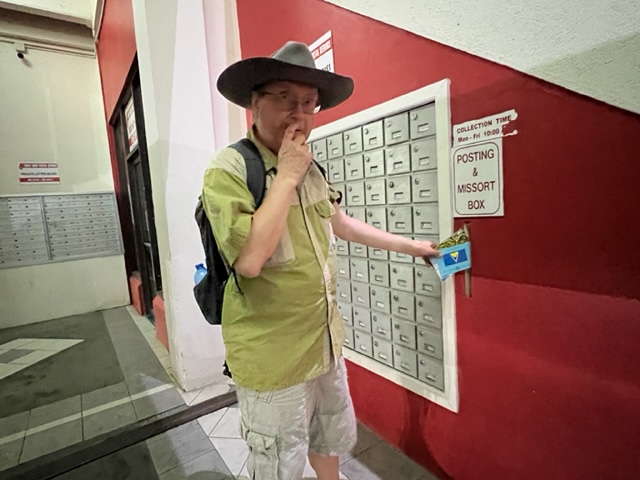
We carefully applied the stamps, took a few photos in front of the closed post office (secretly hoping that maybe a post office employee would magically appear and open the door), and then headed back to our hotel.
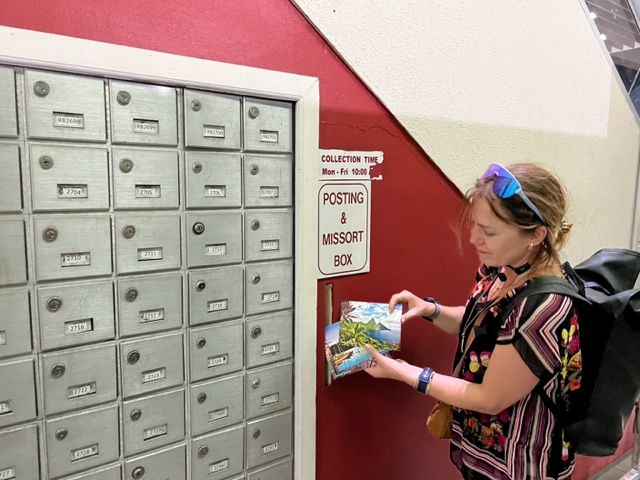
Early the next morning, we boarded our flight and hoped for the best: that the postcards weren’t underpaid, would get properly postmarked, and would eventually reach their destinations. Since the prices at the souvenir shop were noticeably higher than what the official — and quite outdated — price list suggested, we weren’t entirely sure if we had overpaid or simply paid the current rate. Either way, we hoped the cards would travel safely.
The result? The postcards started arriving in the US about two weeks later. As for the rest of the world — including the ones we mailed home to Estonia — they still haven’t arrived.
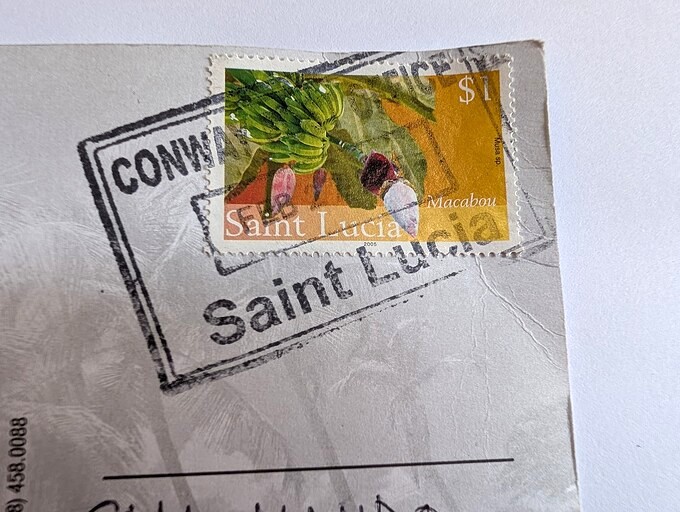
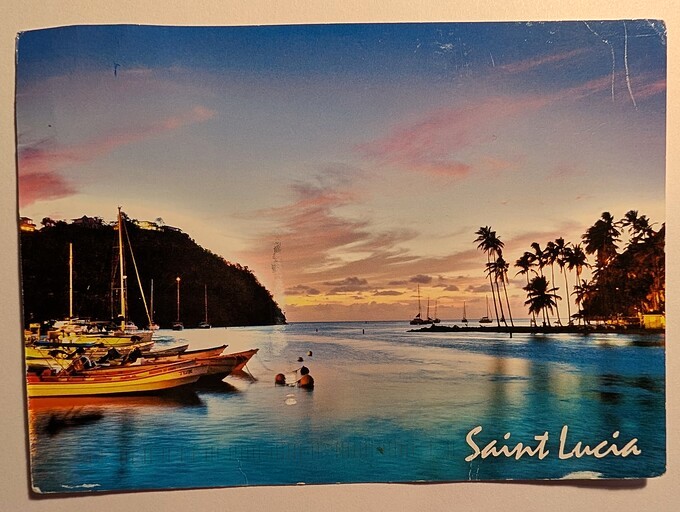
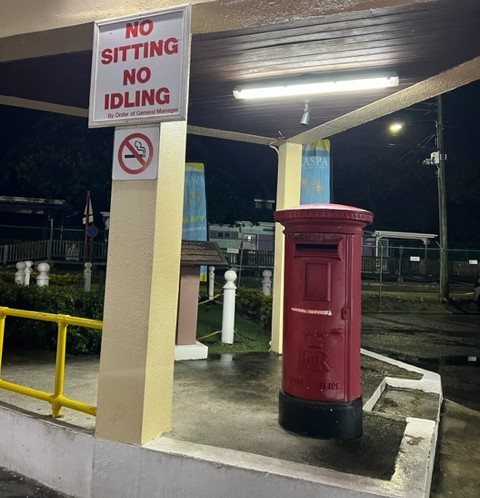
Interestingly, I’ve later seen on postcrossing.com that we’re not the only visitors on this period to test Saint Lucia’s postal system. Others who mailed postcards after us have had them successfully delivered not only to the US, but also to Canada and even China and Japan. For some reason, our postcards just seem to take a bit longer to find their way home.
And if you happen to be a reader who has more up-to-date information about Saint Lucia’s postcard postage or delivery times — feel free to let me know, nexttrip123@gmail.com. I’ll be happy to update the prices if I get some fresh info.
UPDATE (June 14 2025): Since publishing this post, I’ve heard from two fellow Postcrossers who recently tested Saint Lucia’s postal service. Jorge visited the post offices in Castries and Soufriere in February 2025. At the counter, he was told that postcards could only be sent directly to the USA, Canada, and the UK. He bought local stamps, affixed them to his postcards, and had them officially postmarked right at the counter. Cards sent to the US and Canada arrived within a few weeks. The rate he paid was 1 East Caribbean dollar — about 40 US cents.

For the addresses he had received via Postcrossing to Europe and Asia, Jorge had his cards postmarked in Saint Lucia but later mailed them inside an envelope once back home. That way, those cards reached destinations that were otherwise not available directly from Saint Lucia.
Another traveler, Charlotte, mailed her postcards from her resort with the help of the staff. Most of her cards to the UK, USA, and Canada have already arrived, while some to Germany, Australia, and New Zealand are still traveling — or, more likely, as Jorge’s experience suggests, waiting at the Saint Lucia post office until the mailing restrictions change and they can be forwarded.
Big thanks again to both for sharing their experiences — and a special thank you to Jorge for also providing a photo of his Saint Lucia postmarked cards.
If you’d like to read future entries from this post office diary, you can subscribe here:
 Exploring the Unexpected