
- Visit date: November 7 2022
- The visited post office: SALPOST HEAD OFFICE 25/27 Siaka Stevens Street Freetown
- Cost of sending mail: 20 SLE or 20 000 SLL (1,1 EUR) (The stamps we used expired on Dec 31, 2022) Two different currencies and two different types of stamps were used in parallel.
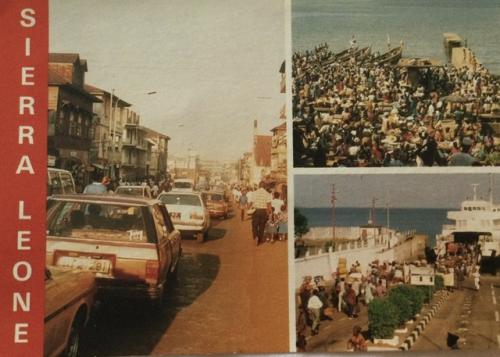
- Postcard availability: Four different types in the Head Post Office
- Postcard Delivery Times: Fastest 12 days to Spain
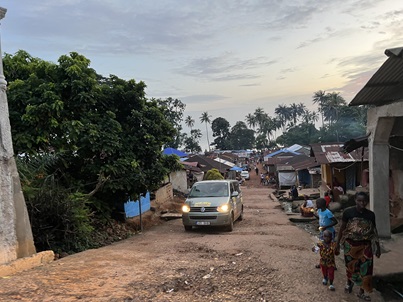
Sierra Leone is a West African country located on the Atlantic coast, bordered by Guinea to the north and Liberia to the southeast. Gaining independence from the United Kingdom in 1961, Sierra Leone’s official language is English, though Krio and other indigenous languages like Mende and Temne are widely spoken. Freetown serves as the nation’s capital. With a diverse landscape of beaches, savannas, and mountains, the country’s history is marked by its role in the transatlantic slave trade and a devastating civil war from 1991 to 2002.
A Brief Overview of Sierra Leone’s Postal History
Sierra Leone’s postal service began in 1841 with a Packets Agent, but a formal General Post Office was established in Freetown in 1853. A full-time Postmaster General position was created in 1858. Unlike some other British colonies, stamps from Great Britain were never officially used in Sierra Leone, although some examples exist from ships with local cancellations. The first Sierra Leone specific stamp was issued in 1859. The colonial period saw various stamp series under British monarchs, often adhering to British colonial omnibus themes.
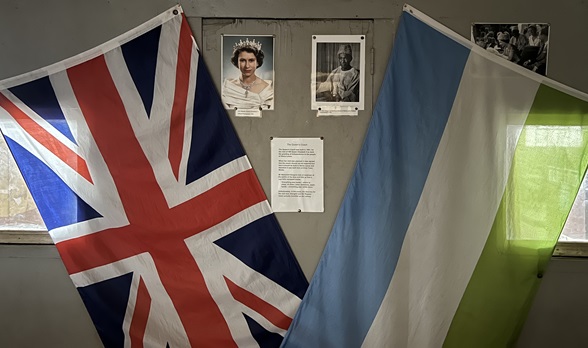
After Sierra Leone gained independence in 1961, the postal service shifted to using the national coat of arms on stamps. In 1964, the currency changed to cents and leones, resulting in the overprinting of existing stamps. The postal service, now known as SALPOST Ltd., incorporated in 1990, continues to operate, navigating the challenges of technological advancements in recent years.
Sources: Wikipedia, Rally, Salpost, Postal history
A Summary of Our Sierra Leone Experience
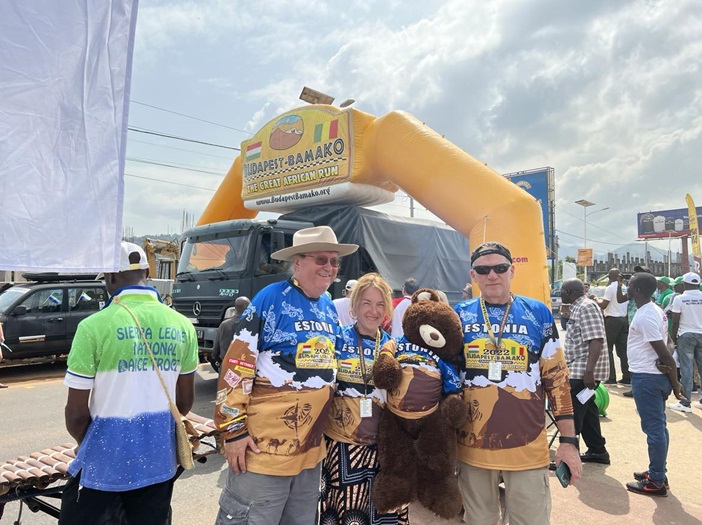
Our visit to Sierra Leone was part of a rally that began officialy in Budapest, but in reality in Tallinn, passing through countries in Europe and down the West African coast. Sierra Leone was the rally’s endpoint, with the capital, Freetown, hosting a grand finish line. The finish line saw organizers, volunteers, various local organizations, and even the country’s president with his entourage. I wrote more about the overall trip here.
Of course, one of our objectives was to find postcards and a post office. Near our hotel, along the street that runs parallel to the beach, there were many small souvenir shops selling mainly textiles and wood carvings, but no postcards. We decided to leave our car—which had carried us for about 10,000 km on this journey so far—in the hotel parking lot. We planned to use local transportation instead. Public transport there is based on minivans (poda poda). As we couldn’t decipher which packed bus to hop on, we opted for a local tuk-tuk (keke), which often drew curious onlookers from the street into the vehicle itself. In this country, it was advisable to keep a close watch on your belongings and not to display your camera or phone publicly, as the keke driver advised.
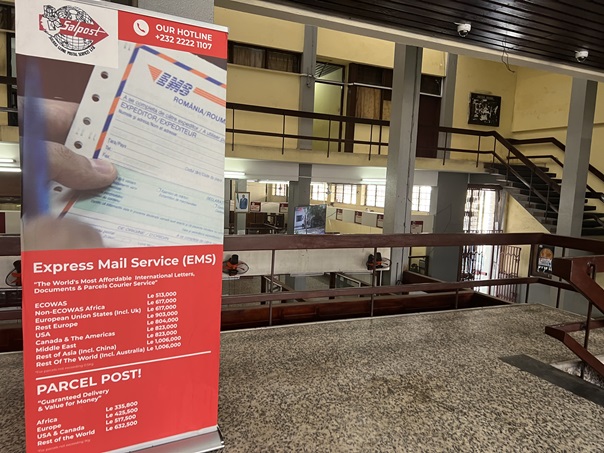
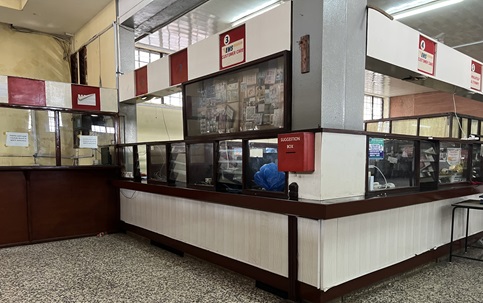
Our destination was the Freetown Central Post Office, as there were no post offices in the area where most hotels were located. Besides handling mail and packages, this post office also serves as a financial institution, telecommunications center, and currency exchange. Upon hearing our request to buy postcards, a staff member led us to a separate room, where they took out four different types of postcards from a cupboard.
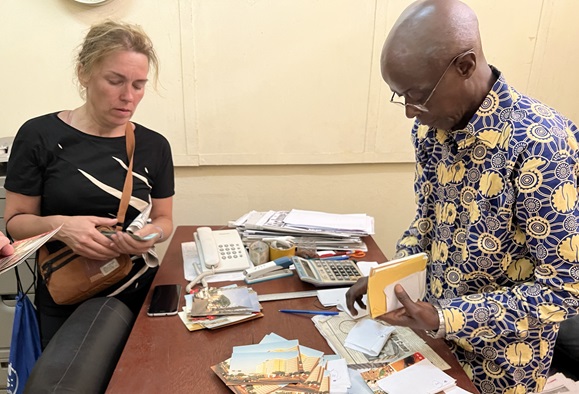
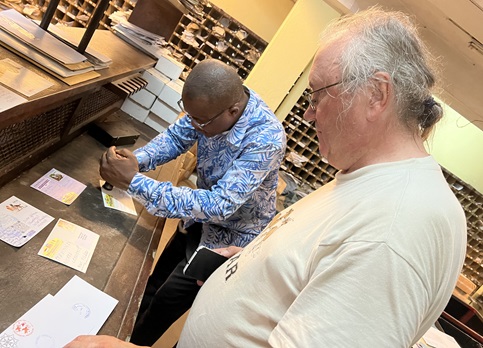
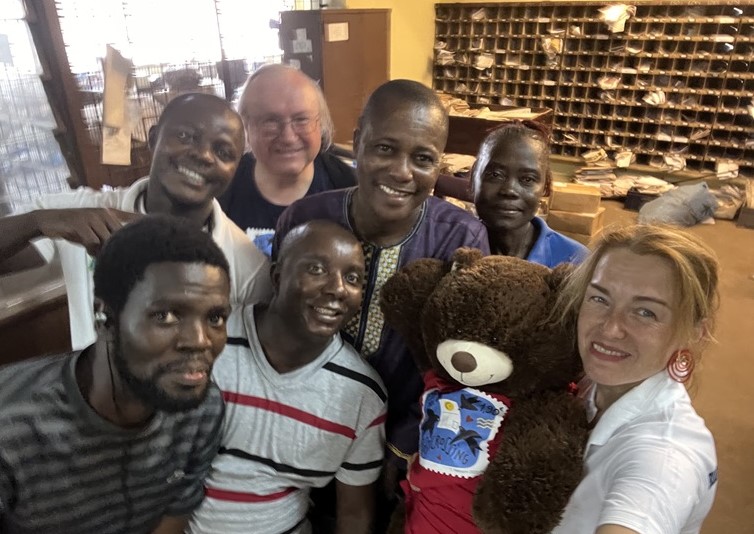
The next day, making the same keke trip and arriving at the post office with our pre-written postcards, we faced a slight hurdle. For a moment, it seemed that the only option was to just drop the postcards into the mailbox until our employee from the previous day appeared and guided us through narrow corridors and up to the third floor of the post office. There, a world of wonder unfolded before us: an old, cloth-covered desk, specially designed for manual stamping, sorting shelves, and the current postmaster and pastor of the Methodist Church, Donald Thomas, with his team. Our conversation with them was truly delightful. Andry himself stamped and sorted our postcards. To top it all off, we gave Donald the last of our donation items (and another team’s): medicines, writing supplies, notebooks, balls, and our Elvis, large teddy bear mascot.
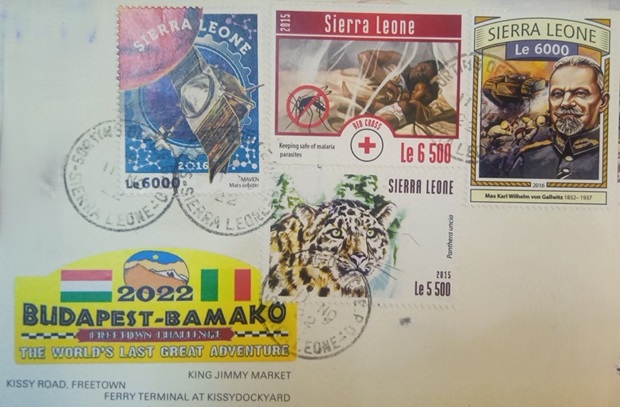
Sierra Leone surprised us in many other ways. Besides the post office, I visited the police department and even the police cybercrime unit, and ended up in the back seat of a car with men trading diamonds and gold. Namely: One participant from Hungary had his iPhone stolen during the rally finish. Though he had already returned home, he saw that his phone was turned back on, and asked for help to see if anyone could look into it to try and get it back. For me, this meant a visit to the police, a ride through the slums on the back of a local motorcycle taxi (okada), and participating in a raid at a local market and also a tour of the cybercrime unit.
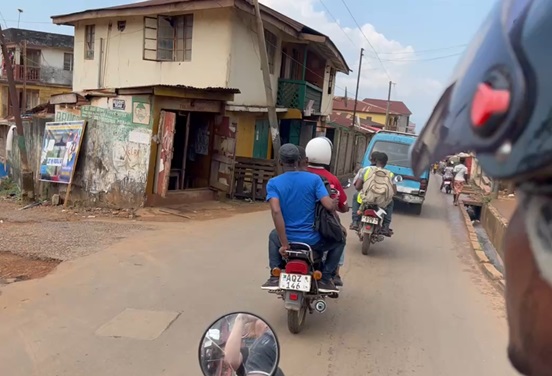
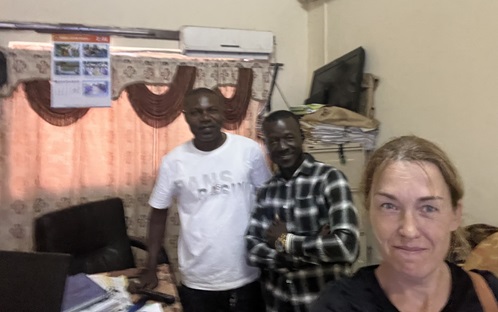
Despite all our efforts, the phone wasn’t recovered. The police had good intentions, but not many resources. I was ready to give a reward for the phone but didn’t know who to give it to. However, this interesting experience showed me clearly that the computers donated by the Hungarian Rotary Club and the solar panels that all of us donated to a local school, went to the right place.
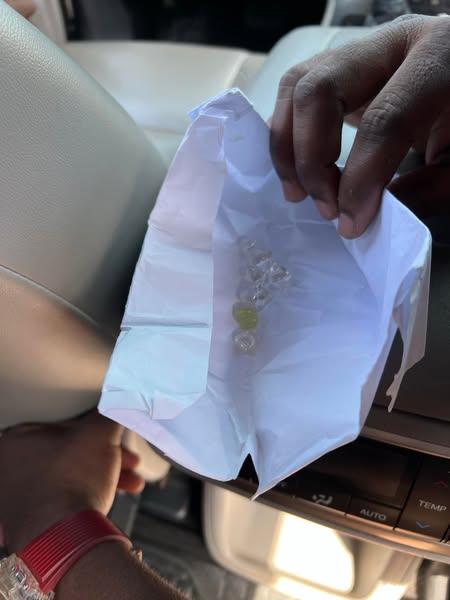
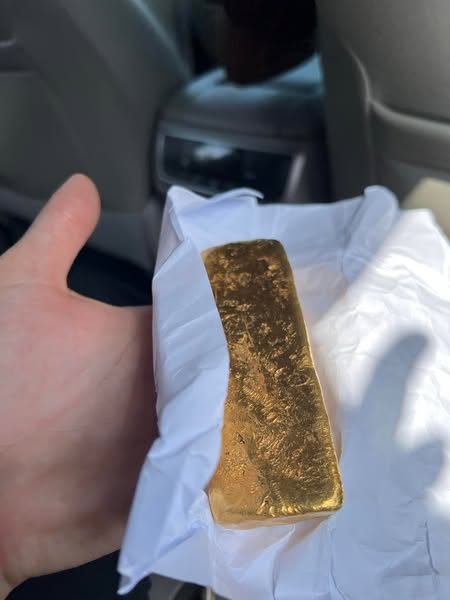
My encounter with gold and diamonds was on hotel grounds. In the parking lot, separated by barriers and checkpoints, a local came up to me wanting to buy our car, offering diamonds in addition to cash. Curiosity got the better of me, and I wanted to see what so-called diamonds looked like in their hands. Thus, in their tinted car, they showed me a bag with unpolished, glass-like stones and a so-called gold bar. Of course, even if we had the money, we had no intention of conducting such a shady deal. They didn’t offer postcards or stamps!
With our flight boarding time approaching, Sierra Leone remained a place of intense contrasts, filled with colorful, almost surreal moments. This post might have veered slightly off the topic of post offices, but that’s where our story went. If there’s one constant truth I’ve found, it’s that those we met within the walls of the post offices have hearts of gold. Until next time, Sierra Leone.
If you’d like to read future entries from this post office diary, you can subscribe here.
 Exploring the Unexpected