
- Visit date: April 13 2012
- The visited post office: Post Office in Yanggakdo International Hotel, Pyongyang
- Cost of sending mail: 140 ₩ (0,15 Eur)
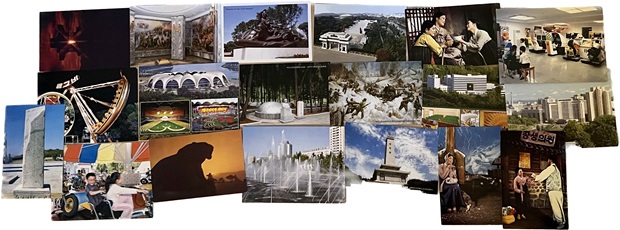
- Postcard availability: Big selection of postcards in Post office counter in hotel lobby
- Postcard Delivery Times: about 3 weeks to Europe
North Korea (or the DPRK, as it’s officially known) isn’t a typical tourist destination. Situated on the northern half of the Korean Peninsula in East Asia, it’s a land steeped in mystery, where the lines between reality and propaganda can feel a little blurry. A country that feels strangely frozen in time.
A Brief Overview of North Korean Postal History

Before the division of the Korean Peninsula, early postal services were informal, relying mainly on couriers between government offices. A modern postal system emerged in the late 19th century under Western influence. In 1884, during the Joseon Dynasty, Korea issued its first stamps, featuring royal symbols and intended for domestic use.
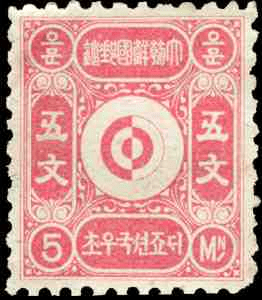
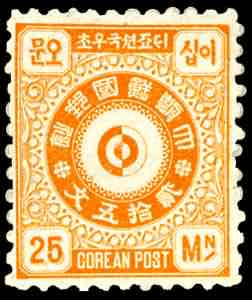
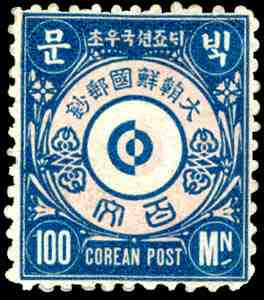
After Japan’s annexation in 1910, the postal system was absorbed into the Japanese network. Following Japan’s collapse and Korea’s division in 1945, North Korea established its own state-controlled postal system, adapting existing infrastructure to serve communist ideology.
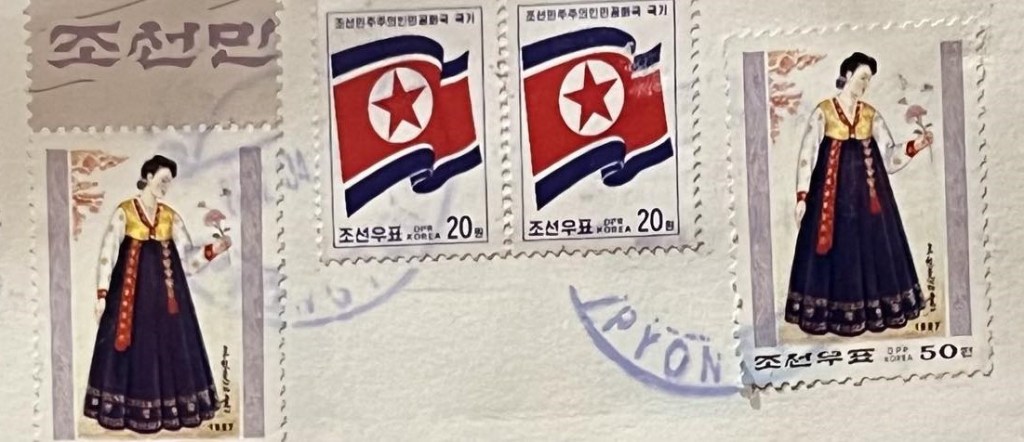
North Korean stamps, issued by the Korea Stamp Corporation, became an important propaganda and revenue tool. Since the 1970s, the country has produced more stamps than South Korea, often featuring patriotic and international themes. Despite its isolation, North Korea has been a member of the Fédération Internationale de Philatélie since 1965. International mail has always been strictly controlled, while domestic postal services are believed to remain in use, particularly in rural areas.
Sources: Postage history of Korea Postage History of North Korea, Korea_Stamp_Corporation Telecommunications_in_North_Korea Korea_Stamp_Museum, Satellite launch
Andry’s DPRK Experience
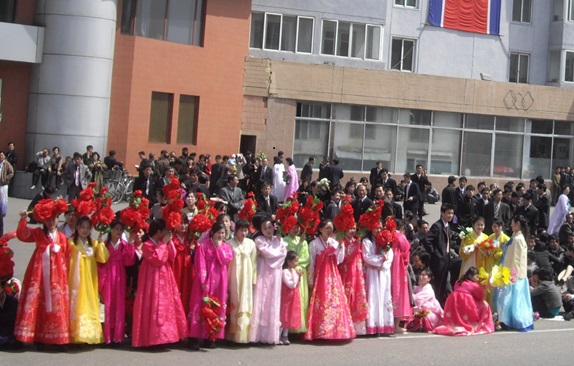
In April 2012, to mark the 100th anniversary of Kim Il-sung’s birth, as well as other national celebrations, the country was in a celebratory mood, allowing more tourists and journalists than usual. Besides concerts and parades, there was also the planned opening of a Postal Museum in the capital on April 9th, as well as the launch of the “Kwangmyongsong-3” observation satellite — a weather satellite, as claimed by the North Korean Committee for Space Technology. This attempt was particularly sensitive to the international community as it was considered a veiled attempt to test ballistic missile technology, prohibited by UN Security Council resolutions.
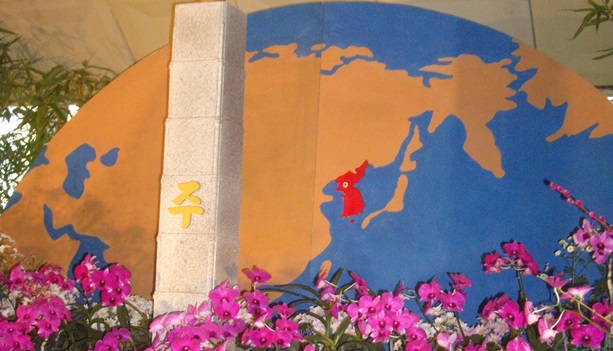
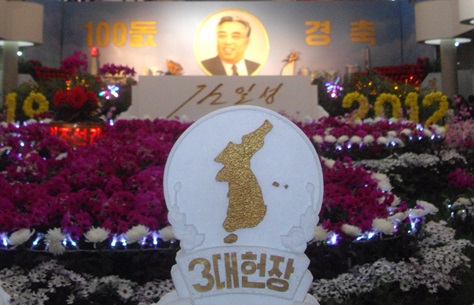
Andry, traveling without me on this occasion, visited the country as part of a twelve-person group from Estonia. Naturally, the group was constantly accompanied by two local guides, who began with an introduction to the country. However, the population and area they described included the entire Korean peninsula, and they stressed that there is only one Korea, but the southern part is temporarily under the harmful influence of the US.
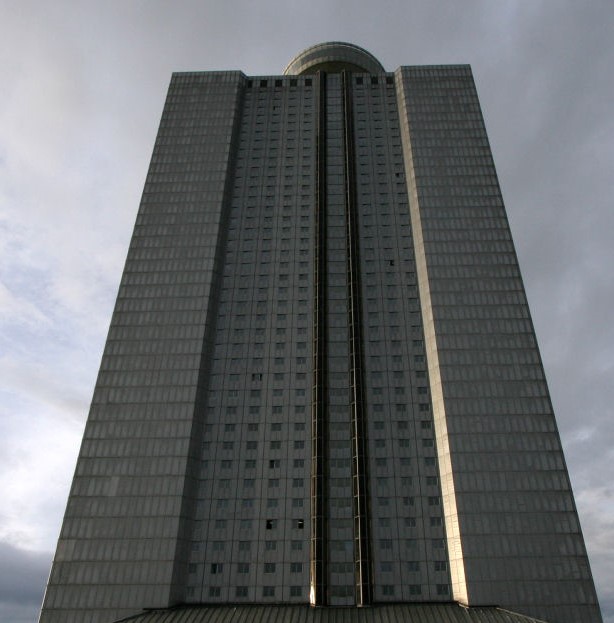
Since the travel agency’s itinerary did not include post offices outside the hotel or the postal museum, and Andry was not allowed to leave the hotel by himself, he used the hotel’s postal service located within the hotel.
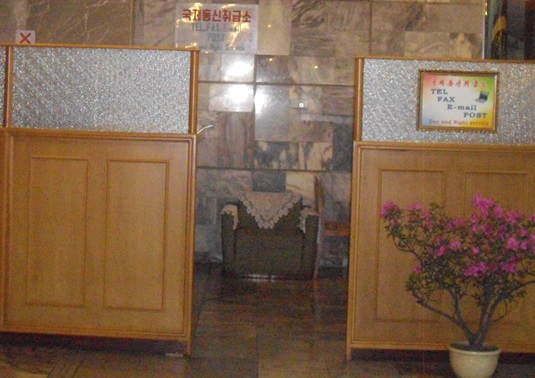
There, the selection of postcards was surprisingly large, at least forty different ones, priced around 10 euro cents each. The selection of stamps was also large, but the range of stamps that could be used on postcards was significantly smaller.
The representative in Post Office informed him (with assistance of a local guide and guard on the same time) that those with Kim or other high-ranking state officials were not allowed to be affixed to postcards. For sending, there were much simpler stamps, but their selection was limited. Andry also noticed that no date stamp was applied to the postcards in his presence. The postcards were taken from the hotel to the mail processing center, where they were, as it turned out, date stamped not the next day, but four days later – this was only visible when the postcards arrived back home.
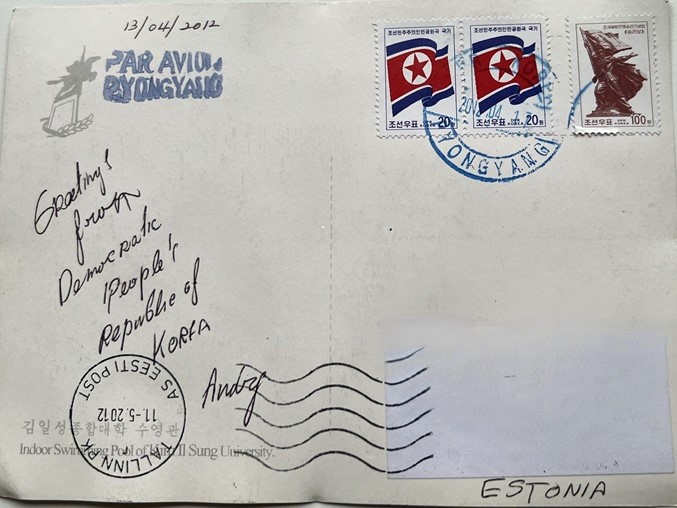
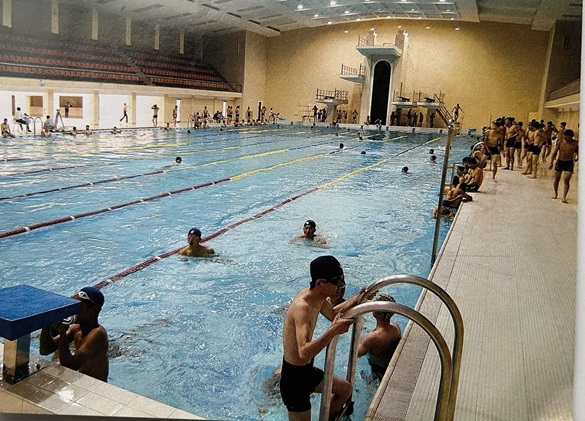
Given the common rumors that all mail was being read, Andry decided to write simply “Greetings from Democratic People’s Republic of Korea” on the postcards, in English, even the one he sent home. This, he reasoned, would be quicker for anyone who might have to read the texts and expedite the delivery. He was also warned not to refer to the country as North Korea, as this might prevent letters from leaving the country.
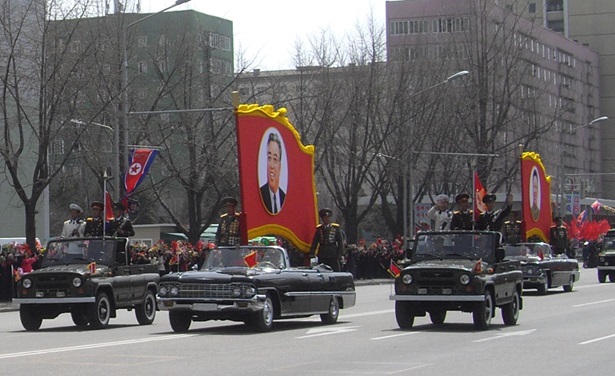
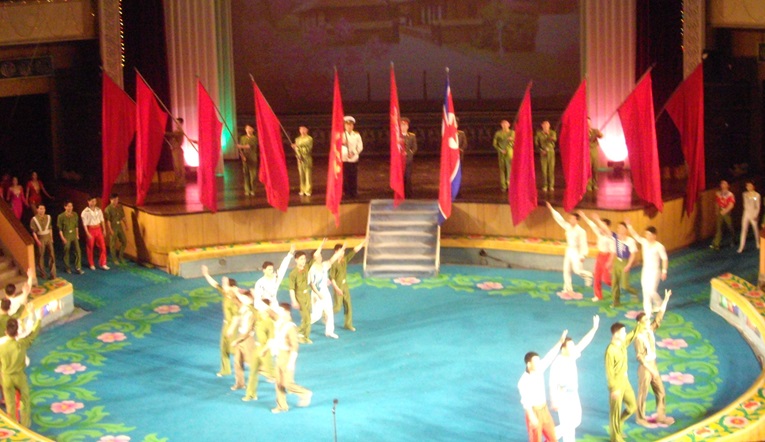
While in the DPRK, Andry’s group was shown various sights as part of their tightly controlled itinerary. They visited a film studio and attended a parade and a performance and a hospital, experiences that could easily fill a separate chapter but are, in this context, a reflection of the country’s carefully curated image.
The event that North Korea was so proud of – the launching of the satellite – was unsuccessful. Shortly after the 7:39 a.m. launch, approximately 90 seconds into its flight, the Unha-3 rocket broke into several pieces and crashed into the Yellow Sea. The state-controlled local news initially reported a successful launch, but because there were many foreign journalists on site, a report of the failed launch appeared even there within a few hours.

Be that as it may, the postcard launch was successful. They made it out of the country and reached their destinations, though a little worse for wear, most within less than a month. Andry, of course, returned even earlier. Among other things, he brought back local beers, which we sampled with friends, and ranked – the experience wasn’t a positive culinary one, but it certainly complemented Andry’s colorful tales of this closed-off country. I have to admit that, along with his vivid stories of the trip, I, too, got an experience.

Update (December 2025) – postal context: International mail from North Korea was heavily disrupted during the COVID-19 period. After a prolonged pause, confirmed postcards from North Korea began appearing again in December 2025. While sending postcards is currently possible, the process remains tightly controlled.
If you’re interested in places where sending a postcard is more than just dropping it in a mailbox, you might also like my posts about Somaliland, Sudan or Pitcairn Island.
If you’d like to read future entries from this post office diary, you can subscribe here.
 Exploring the Unexpected